Every owner eventually has to raise prices at a nail salon, and most wait too long. Rent goes up, gel and acrylic cost more, technicians deserve better pay and card fees take a bigger bite, yet the menu stays the same for years because nobody wants to upset regular clients. Then one day the numbers no longer work and the salon has to make a big, sudden jump, which is exactly what upsets clients most.
The good news is that clients accept price changes far better than owners expect when the change is reasonable, announced ahead of time and explained honestly. This guide covers the signs that it is time, how to calculate the increase, which services to change, when and how to announce it, ready-to-use templates, what to say at the front desk and every place you need to update.
In this article
- Signs it is time to raise prices
- How much to raise prices
- Which services to change
- When to raise prices
- Honor what clients already have
- A timeline for your price change
- How to announce a price increase
- Templates you can adapt
- What to say at the front desk
- Regulars and new clients
- When a client leaves over price
- Use the moment to refresh your menu
- Different salons, different approaches
- Update everything on the same day
- Share the increase with your team
- Avoid hidden fees
- Practice the conversation with your team
- Track the results
- Add value clients can see
- Mistakes to avoid
- How Dreamer helps
- Frequently asked questions
Signs it is time to raise prices
- Costs have risen since your last price change: rent, products, wages, insurance, card processing.
- Your schedule is full days or weeks ahead, especially with your best technicians.
- Your margins are shrinking even though the salon is busy.
- You have not changed prices in two years or more.
- Your prices are well below comparable salons nearby while your quality, hygiene and experience are equal or better.
- You want to pay technicians more to keep good people.
If two or three of these are true, a price review is overdue. Our guide on how to price nail services shows how to calculate prices from product cost, overhead, time, pay and card fees, which is the best starting point.
How much to raise prices
Base the increase on your numbers, not on a feeling. Recalculate each service with the pricing formula, compare the result with your current price and with the market, then decide. A few principles help:
- Small and regular beats big and rare. A modest yearly increase is easier to accept than a large jump every five years.
- Look at general inflation as a reference; the Bureau of Labor Statistics publishes the Consumer Price Index every month. Your own costs may rise faster or slower than the index.
- Round to clean numbers. A change from $40 to $45 is clearer than one to $43.50.
- Change services individually, not every price by the same percentage.
Which services to change
Not every service needs the same increase. Focus on:
- Services that are fully booked, where demand is clearly higher than capacity.
- Long or complex services whose prices do not reflect the time they take, such as full sets with art or deluxe pedicures.
- Senior technicians with waiting lists; technician levels with different prices reward skill and spread demand.
- Add-ons and nail art, which often stay underpriced for years.
Consider keeping one or two popular entry services, such as a classic manicure, at a stable price. That gives price-sensitive clients a familiar option and makes the overall change feel fair.

When to raise prices
Pick a date and announce it in advance. Many salons choose the start of a year or a season, after a holiday rush rather than right before it, so the change does not land in the middle of clients' busiest booking period. Avoid changing prices in the middle of a promotion, and never surprise a client at checkout with a price that was different when she booked.
Give clients two to four weeks of notice. It feels respectful, gives regulars time to book at the old price if they want, and reduces surprises at the front desk.
Honor what clients already have
- Appointments booked before the announcement should be charged at the price shown when they booked.
- Gift cards with a dollar value keep their full value; they simply buy a little less.
- Gift certificates for a specific service should be honored as written.
- Prepaid packages and memberships keep their terms until they end; announce new terms for renewals.
These small courtesies show clients you are fair, and they prevent the most common disputes.
A timeline for your price change
| When | What to do |
|---|---|
| Six weeks before | Recalculate each service, compare with the market and decide the new prices |
| Four weeks before | Prepare the new menu design, website text, booking changes and announcement messages |
| Three weeks before | Announce in the salon, online and by email or text; brief technicians |
| One week before | Send a short reminder and check that everything is ready to switch |
| Effective date | Update the wall menu, website, booking system, Google profile and POS together |
| One to three months after | Review bookings, repeat visits, average ticket and comments |
Writing the dates down keeps the change calm and organized instead of rushed.
How to announce a price increase
Use several channels so nobody is surprised:
- A sign at the front desk and near the wall menu with the effective date.
- Your website and booking system, with a short note on the services page.
- Email or text to clients who agreed to receive messages from you; see our guides to nail salon email marketing and nail salon text message marketing for the rules.
- A social media post for followers.
- Technicians, who mention it briefly and kindly to their regular clients.
Keep the message short, positive and specific: what changes, when and why, with thanks for their loyalty. Do not apologize at length or make it sound like bad news; explain it as part of running a quality salon.
Templates you can adapt
Sign at the front desk:
New prices starting March 1. To keep using quality products, pay our team fairly and maintain the high standards you expect, some of our prices will change on March 1. Thank you for being part of our salon family.
Text message:
Hi Anna, a quick note from Lotus Nails: some service prices will change on March 1. Appointments booked before then keep today's prices. Thank you for choosing us! Reply STOP to opt out.
Email:
Subject: A small update to our prices Thank you for trusting us with your nails. Over the past two years, the cost of quality products, rent and fair pay for our technicians has risen, and we have kept our prices the same as long as we could. On March 1, some prices will change; you can see the new menu on our website. Appointments booked before March 1 keep today's prices, and gift cards keep their full value. We look forward to seeing you soon.
Use your real salon name and dates, and keep the tone your clients know.

What to say at the front desk
Most clients say nothing, some ask why, and a few complain. Prepare your team with calm, short answers:
- "Why did prices go up?" "Our costs for products, rent and our team have risen, and we want to keep the quality you come here for."
- "It's too expensive now." "I understand. Our classic manicure is still at the same price, if you'd like that option."
- "The salon down the street is cheaper." "Every salon is different. Here you get new files for every client, disinfected tools and technicians who take their time."
Never argue, never blame the technician, and never offer a discount on the spot to calm someone down; it undermines the whole change. Most clients who grumble come back.
Regulars and new clients
Some salons phase in the change for long-time regulars, for example by keeping their current prices for an extra month or two while new clients pay the new prices immediately. It is a kind gesture, but it adds complexity at the desk and in the booking system, and it must be applied consistently to avoid feelings of unfairness. If you choose it, define who counts as a regular, set a clear end date and write it in the announcement. If you prefer simplicity, one date for everyone with good notice is perfectly fair.
When a client leaves over price
A few clients may leave, and that is normal. Thank them for the time they spent with you, keep the door open and do not chase them with discounts. Salons that try to keep every price-sensitive client at any cost end up with crowded schedules, tired technicians and thin margins. The clients who stay after a fair, well-explained increase are the clients who value your work, and their loyalty is what a healthy salon is built on.
Use the moment to refresh your menu
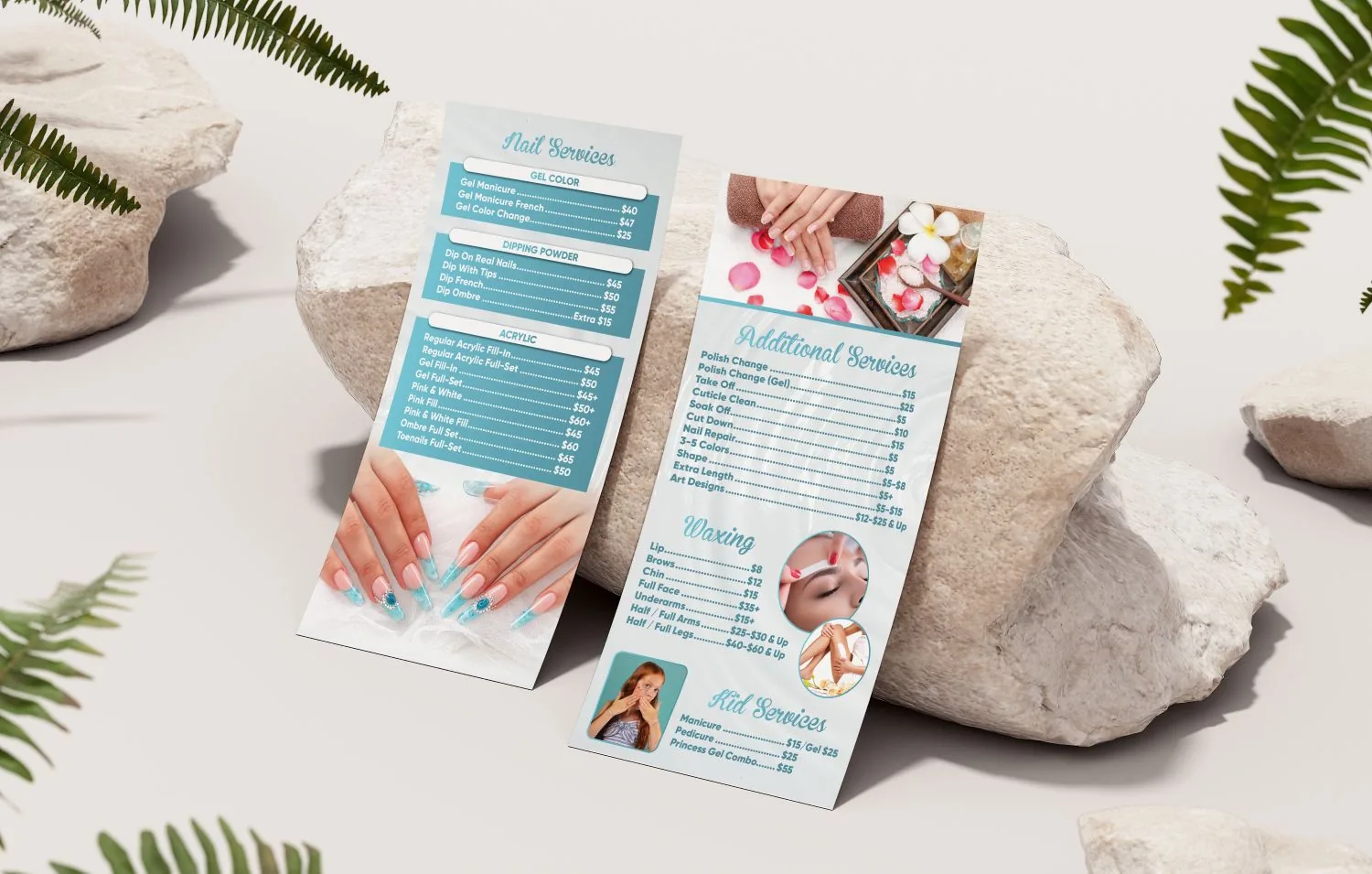
A price change is the perfect time to clean up the menu itself. Remove services nobody books, combine confusing options, rename services so clients understand them and add short descriptions of what each includes. Group services the way clients think, show add-ons clearly and make sure prices are easy to read from the chair. Our guide to nail salon menu design explains layout and wording, and a fresh design makes the new prices feel like an upgrade rather than just a higher number.

Different salons, different approaches
How you raise prices also depends on how your salon works. Walk-in salons rely on the wall menu and signs, so the in-salon announcement matters most. Appointment-based salons can announce through the booking system, confirmations and reminders, so clients see the new price before they arrive. Premium salons usually change prices less often but by more, with a strong explanation of value, while busy value salons do best with small, frequent changes that clients barely notice.
Update everything on the same day
Mismatched prices create more conflict than the increase itself. On the effective date, update:
- The wall menu and printed price lists; Dreamer can reprint your wall menu quickly from the saved design.
- Your website services page.
- Your booking system, including service prices and durations.
- Your Google Business Profile services and prices.
- Your POS buttons and service list.
- Any flyers, social media highlights and pinned posts that show prices.
Brief every technician before the change so everyone quotes the same numbers.
Share the increase with your team
A price increase is also a chance to keep good technicians. If they earn commission, their pay rises automatically with prices; tell them so. If they earn hourly wages, consider raising pay at the same time. Technicians who benefit from the change explain it to clients with more conviction, and they are less likely to leave for another salon. Our guide on how to hire nail technicians covers retention in more detail.
Avoid hidden fees
Some salons try to avoid a visible price increase by adding a "supply fee", "service fee" or card fee at checkout. That usually frustrates clients more than a clear price change, and in some states it is restricted. California's honest pricing law, for example, requires the advertised price to include mandatory fees, as the state Attorney General explains on its hidden fees page. Card surcharges have their own rules; our article on cash discount vs surcharge explains them. In most cases, a clear new price is simpler, fairer and safer.
Practice the conversation with your team
Before the announcement, spend ten minutes at a team meeting practicing the answers above. Let technicians say them out loud in their own words, in English and in the languages they speak with clients, and agree on what to offer a client who wants a less expensive option. Confident, consistent answers from every technician make the change feel normal; nervous or different answers make clients think there is something to negotiate.
Track the results
For two or three months after the change, watch a few numbers:
- Bookings per week compared with the same period last year.
- Repeat visits from regular clients.
- Average ticket.
- Comments and complaints at the desk and in reviews.
A small dip in the first weeks is normal. If bookings stay healthy and the average ticket rises, the increase worked. If one service loses many clients, review that price, not the whole menu.
Add value clients can see
Price increases go down easier when clients notice improvements: a new product line, sealed tool pouches opened in front of them, a longer massage, better ventilation, online booking, a refreshed waiting area. Mention these in your announcement and show them on social media, without exaggeration. Our guide to nail salon client retention has more ideas for keeping regulars happy.
Mistakes to avoid
- Waiting years, then raising prices sharply.
- Raising everything by the same amount without looking at each service.
- No advance notice, or surprises at checkout.
- Different prices on the wall, website, booking system and Google.
- Hidden fees instead of honest prices.
- Apologizing too much or offering discounts to anyone who complains.
- Not telling technicians before clients hear about it.
How Dreamer helps
Dreamer makes price changes simple: we update your website and booking prices, refresh your Google Business Profile services through Social Marketing, design the announcement posts for social media and reprint wall menus, price lists and signs through our design and printing service, all on the same day so every price matches.
Frequently asked questions
How often should a nail salon raise prices?
Review prices every year. Small, regular increases are easier for clients to accept than large, rare ones.
How much notice should clients get?
Two to four weeks is common. Honor appointments booked before the announcement at the old price.
Will I lose clients if I raise prices?
You may lose a few price-sensitive clients, but most regulars stay when the increase is reasonable, explained and paired with consistent quality.
Should I raise all prices at once?
Not necessarily. Change services individually based on time, demand and cost, and consider keeping one popular entry service stable.
Can I add a supply fee instead of raising prices?
It is usually better to raise prices clearly. Some states, such as California, require mandatory fees to be included in the advertised price.
What should technicians say when clients ask about the change?
A short, calm explanation about costs and quality, an alternative service if the client wants one, and no discounts on the spot.
To raise prices at a nail salon successfully, base the change on real numbers, focus on the right services, give clear notice, honor what clients already have and update every menu on the same day. Explain it with confidence and keep delivering the quality that brought clients to you. Done this way, a price increase becomes a normal, healthy part of running your salon rather than a crisis.