Nail salon business cards are the smallest thing you print and often the hardest-working. A card in a client's wallet or on her fridge is a reminder of your salon every time she sees it, and it is the easiest thing for her to hand a friend who compliments her nails. Yet many salons print a front with a name and a phone number and leave the back blank, wasting half the card.
This guide covers what the front of your card needs, ten smart ideas for the back, how to choose paper and finishes, sizes and shapes, how many cards to print, how to hand them out so they do not end up in the trash, and a checklist to run before you approve the proof. The examples come from real cards we designed and printed for salons.
In this article
- Why nail salon business cards still matter
- What the front of the card needs
- 10 smart ideas for the back of nail salon business cards
- Ready-to-use text for the back
- Choosing paper and finish
- Sizes and shapes
- How many cards should you print?
- Seven design rules for salon cards
- Handing out cards so they get kept
- Business cards for a grand opening
- Your business card and your other print pieces
- Measuring whether your cards work
- Mistakes to avoid
- Checklist before you approve the proof
- How we design and print salon cards
- Frequently asked questions
Why nail salon business cards still matter
Most clients find salons on their phones now, but they remember salons through things they can hold. Business cards do three jobs a screen cannot.
They remind. An appointment card with next month's date stuck on the fridge works better than a text that gets buried under fifty other messages.
They travel. Clients hand cards to coworkers and friends who ask about their nails. A personal recommendation with a card attached is the most trusted kind of referral.
They connect offline to online. A QR code on the back can take a client to your booking page, your Instagram or your Google review page, turning a small piece of paper into a doorway to your salon online.
What the front of the card needs
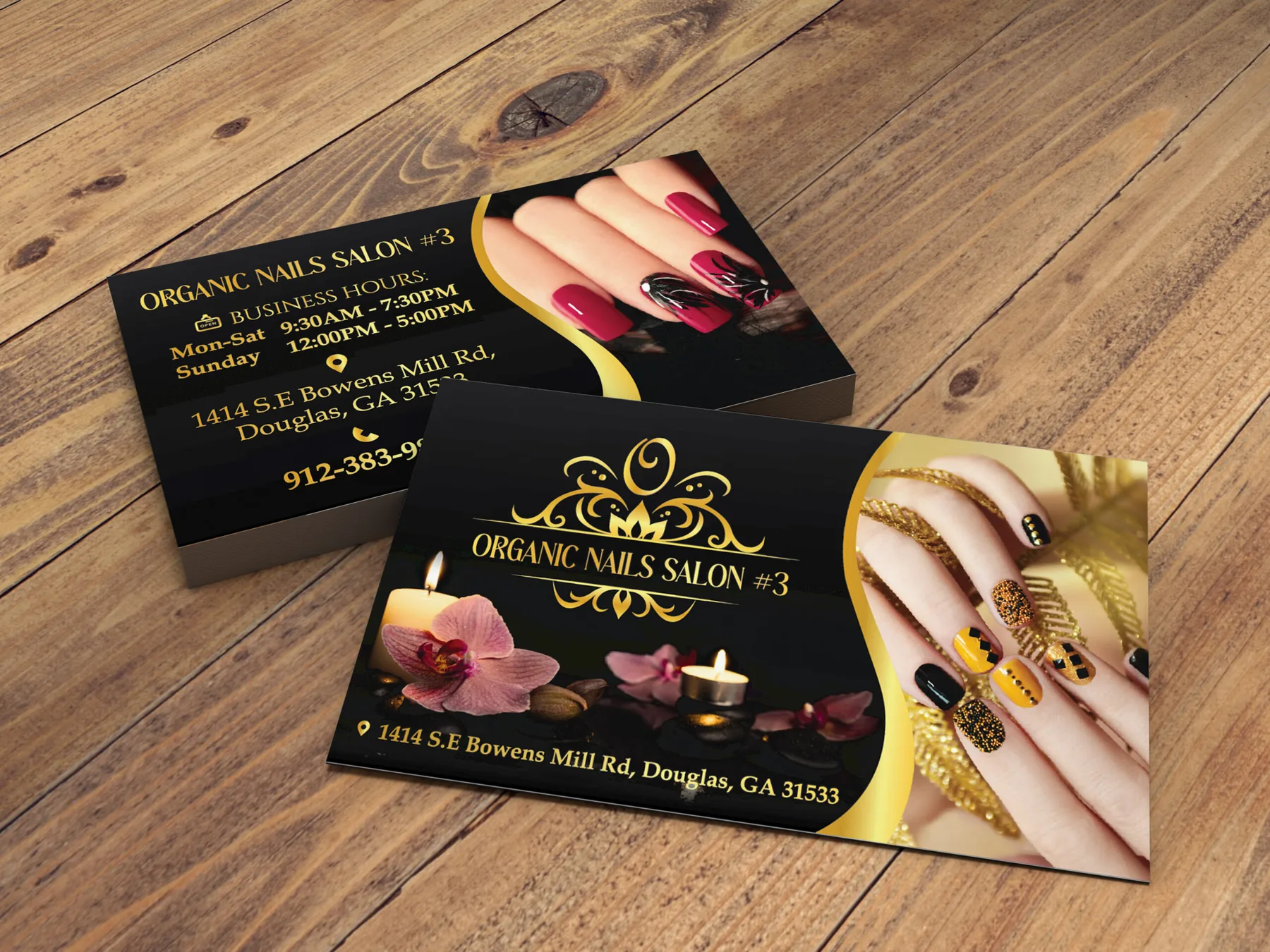
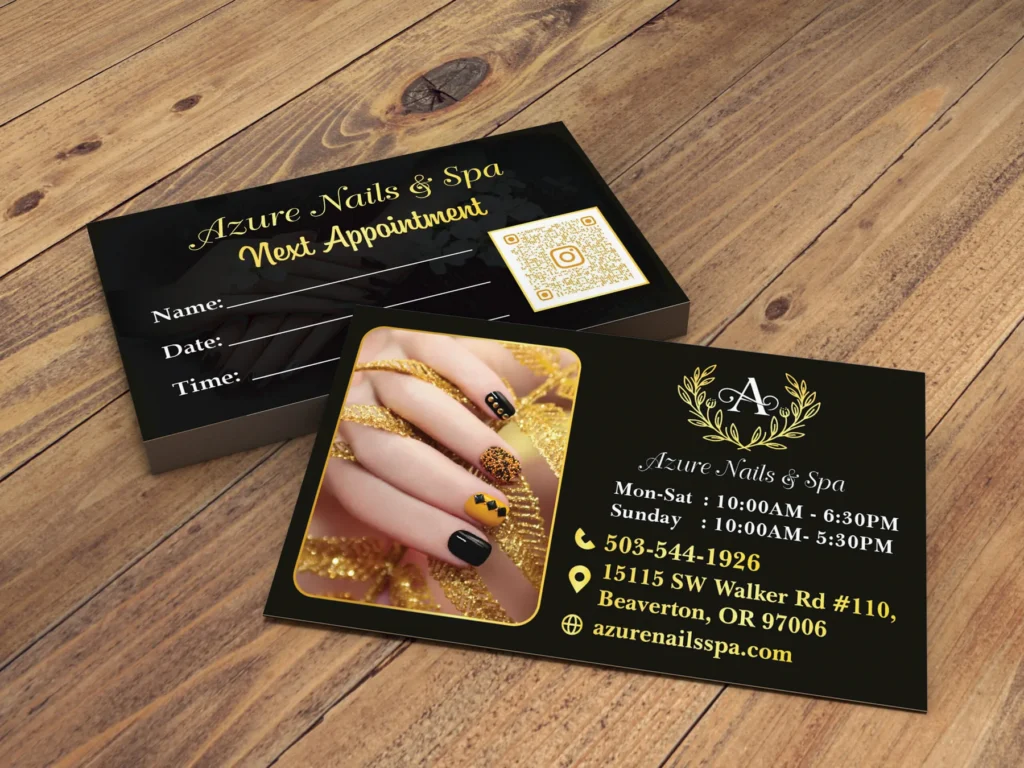
Keep the front clean and focused on five things:
- Your logo and salon name exactly as they appear on your sign.
- Your phone number, the largest and clearest text on the card.
- Your address with suite number, plus a landmark if you are in a large shopping center.
- Your website or booking page.
- Your Instagram or Facebook handle if you post regularly.
Hours can go on the back if the front feels crowded. Skip the email address unless clients really use it to book.
10 smart ideas for the back of nail salon business cards
The back is where the card earns its keep. Pick one job for each type of card; many salons print two or three versions for different purposes.
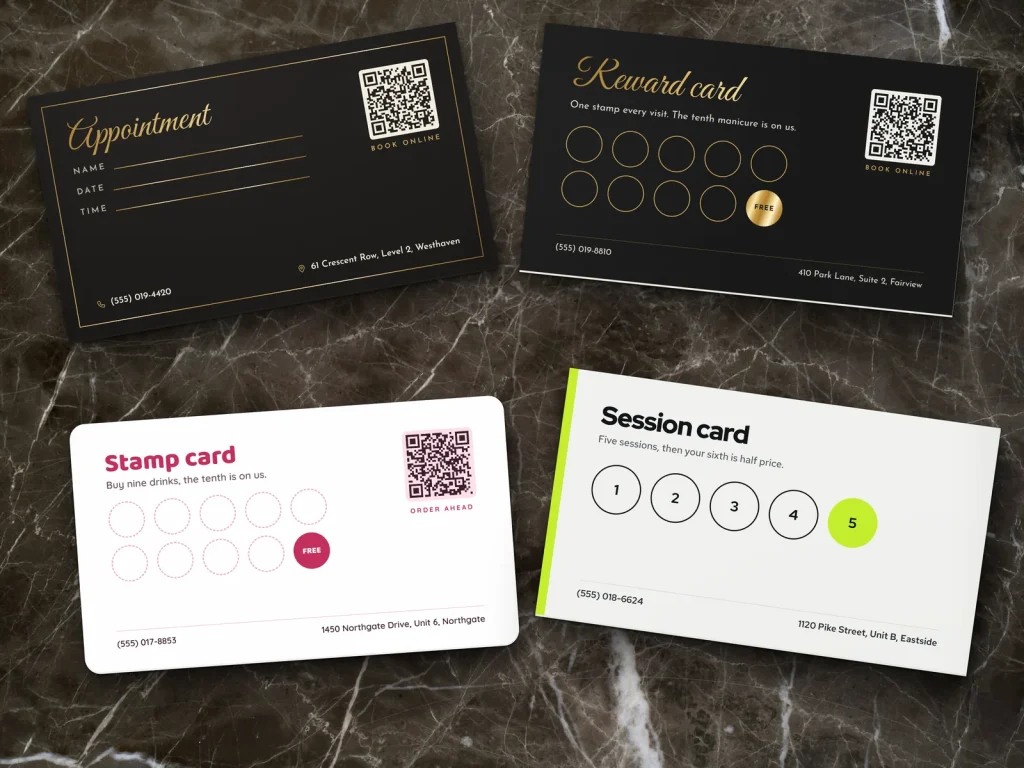
1. An appointment card
The classic: a few lines for the date, time, service and technician. The technician fills it in at checkout. If the back is an appointment card, choose a matte or uncoated back so a ballpoint pen writes cleanly.
2. A next-visit coupon
"10% off your next pedicure within 30 days" or "Free paraffin with your next spa pedicure". Print clear terms and an end date. A coupon gives clients a reason to come back sooner, and every card that returns tells you the offer worked.
3. A referral card
"Give this card to a friend: she saves on her first visit, and you save on your next." Referral cards suit nail salons especially well, because clients often come with friends, sisters and coworkers.
4. A loyalty punch card
Ten boxes to stamp, with a reward on the tenth, such as a free manicure. Paper punch cards work well for salons without a loyalty program in their POS. For a card that lasts longer in a wallet, look at plastic cards.
5. A QR code for Google reviews
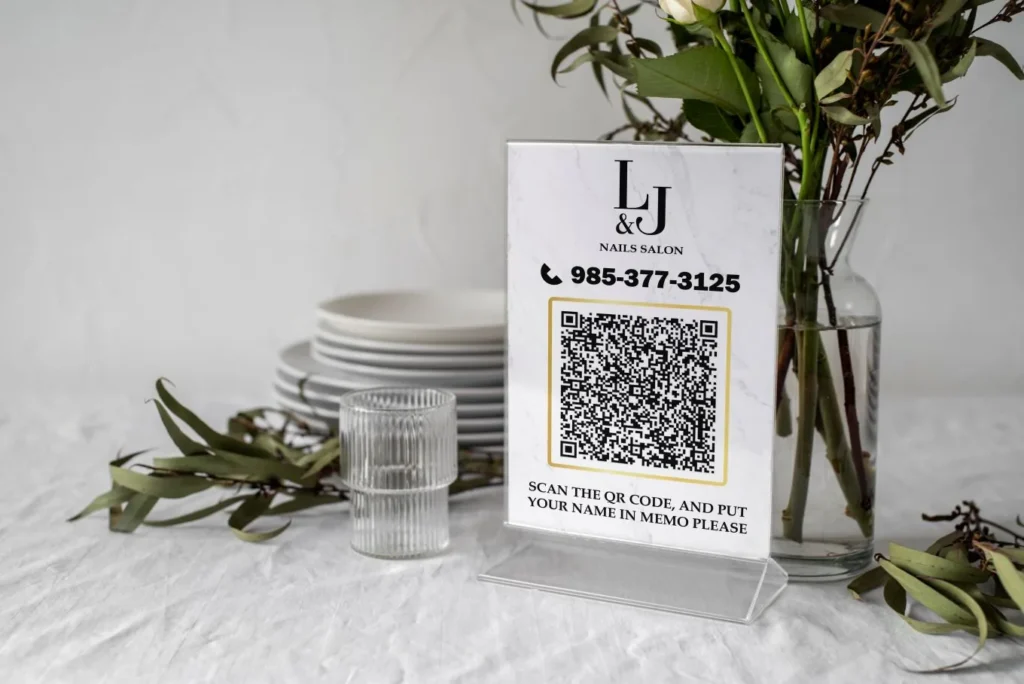
A QR code that opens your review page, with a line such as "Loved your nails? Tell us on Google." Google encourages businesses to share a link or QR code to ask for reviews. Never offer a discount or gift in exchange for a review; the FTC's rule on consumer reviews has banned that since October 2024. And leave Yelp off the card: Yelp asks businesses not to request reviews at all.
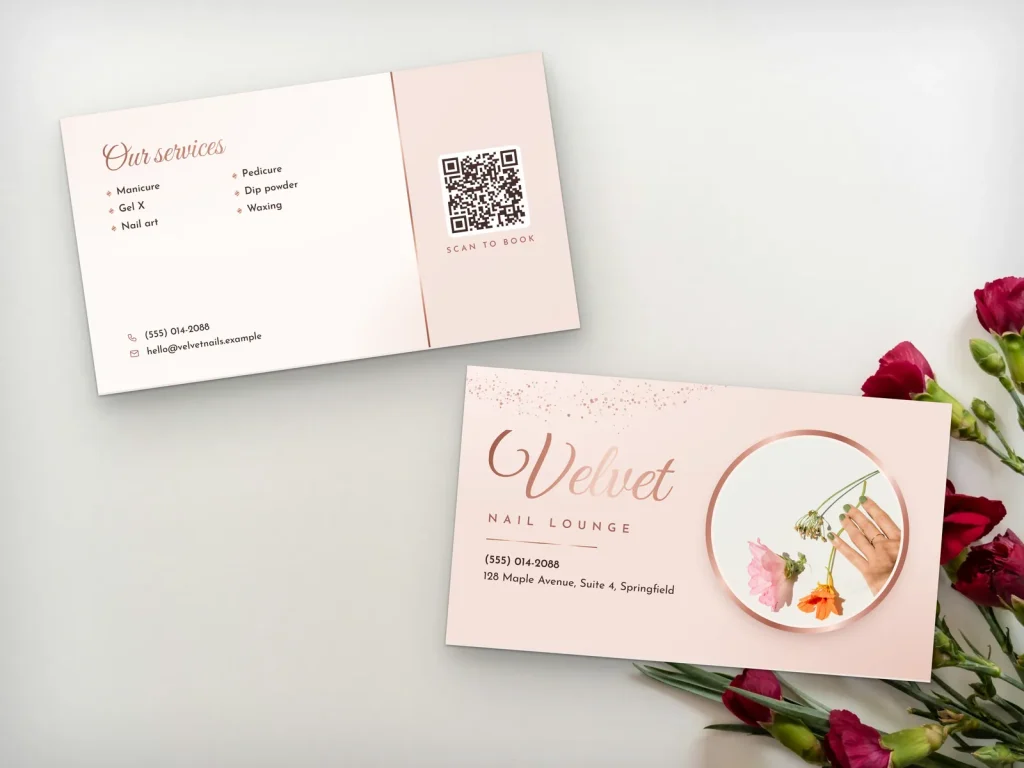
6. A QR code for online booking
"Book your next visit in 30 seconds" with a QR code to your booking page. This is ideal for salons that want fewer phone calls during busy hours.
7. A mini price list
Five or six of your most popular services with "from" prices. Clients keep the card as a pocket menu and know roughly what to expect when they call.
8. Hours and directions
Daily hours and a one-line direction such as "Upstairs, next to the food court entrance". This helps salons that are hard to find in large plazas.
9. A technician's own card
The front shows your salon logo; the back shows the technician's name, specialties and Instagram. Regulars keep the card of the technician they love and book the right person every time. Matching name tags for the team complete the look.
10. Aftercare tips
"Gel care: avoid hot water for a few hours, use cuticle oil daily, wear gloves for cleaning, never peel your gel." Clients appreciate the care, their nails last longer, and you get fewer complaints.
Ready-to-use text for the back
Four short versions you can adapt:
Appointment: "Your next visit: Date ______ Time ______ Service ______ Technician ______. Need to reschedule? Please call us 24 hours ahead."
Coupon: "Thank you for visiting! Enjoy 10% off your next pedicure within 30 days. Present this card at checkout. One per visit."
Referral: "Share the love: give this card to a friend. She saves on her first visit, and you save on your next. Your name: ______."
Aftercare: "Keep your gel looking fresh: cuticle oil every day, gloves for cleaning, and come back for a gentle soak-off."
Short text reads best. If the back fills up with a paragraph, cut words or switch to a folded card.
Choosing paper and finish
The paper and finish decide how a card feels in the hand:
- 14pt stock: thick and sturdy, the common choice for salons.
- 16pt stock: stiffer, with a more premium feel.
- Gloss finish: vivid color, good for cards with photos.
- Matte finish: refined, less glare under salon lights, and better for writing on.
- Triple-layer cards: three sheets pressed together for a very thick, premium card; see our triple-layer business cards.
For everyday cards in larger quantities at a lower cost per card, start with standard business cards.
Sizes and shapes
The US standard is 3.5 × 2 inches, which fits every wallet and card holder. To stand out, consider die-cut business cards: round, oval, leaf-shaped, rounded corners or folded. Shaped cards have less room, so keep the text short.
A folded card opens to four panels, enough for a punch card and a mini price list together. It is a good choice when you want one card to do several jobs.
How many cards should you print?
There is no single right number. A simple way to estimate: your weekly client count, multiplied by the number of weeks you want this batch to last, plus extra for partner businesses. Larger runs cost less per card, but do not over-print if your phone number, prices or logo might change soon.
A practical split: print your general information card in a larger run that lasts a long time, and print coupon or referral cards in smaller runs you can change with the seasons.
Seven design rules for salon cards
- Make the phone number the easiest thing to read.
- Keep text large enough for older clients to read without glasses.
- Use strong contrast. Gold foil on black looks great for a logo, but small text should be solid color.
- Leave white space. A crowded card looks cheap; a clean one looks confident.
- Match your brand. Same colors and fonts as your menu, gift certificates and sign.
- Use a sharp logo file, ideally vector, never a screenshot.
- Respect safe margins. Keep text at least 0.125 inch from the edge and add 0.125 inch bleed when the background runs to the edge.
Handing out cards so they get kept
A box of beautiful cards does nothing on a shelf. Ways to get them into the right hands:
- Hand one to every client at checkout, with the next appointment written on it.
- Drop one in every retail bag when clients buy cuticle oil or polish.
- Keep a card holder at the front desk and at each station, so clients can take extras for friends.
- Tuck a card into every gift certificate envelope, so the person receiving the gift has your details. Our guide to nail salon gift certificates covers how to sell more of them.
- Leave a stack with partner businesses nearby, such as a hair salon, a yoga studio or a coffee shop, in exchange for theirs.
- Let each technician hand out her own card to her regulars.
Business cards for a grand opening
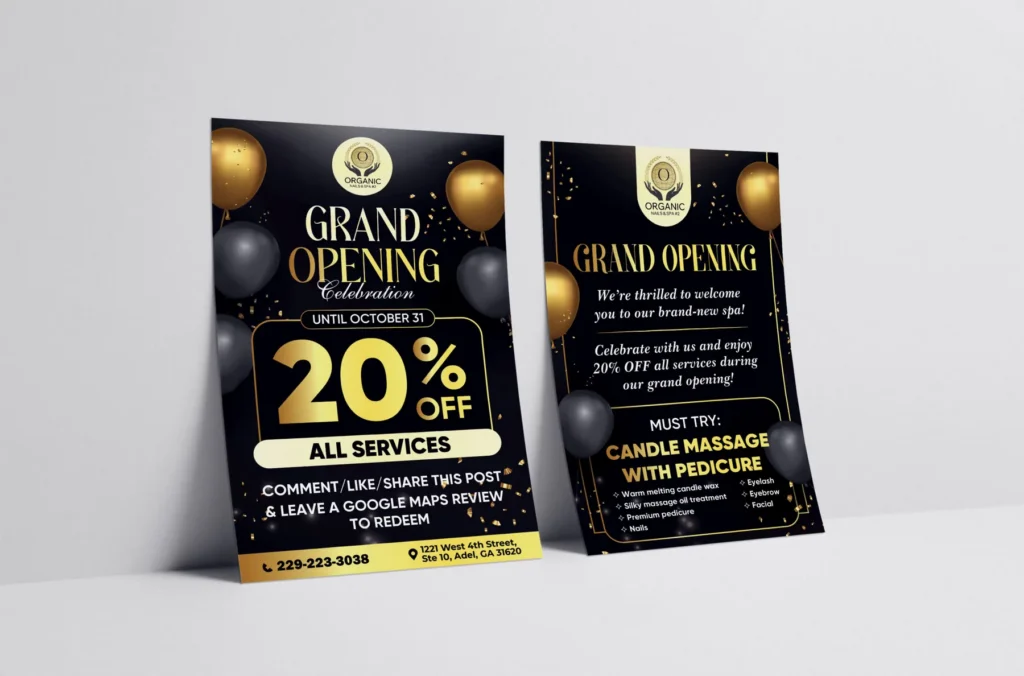
A new salon needs its first business card to do one more job: introduce the salon to the whole neighborhood. Make the back of the first batch a grand opening offer with a clear end date, plus very clear directions, because nobody knows where you are yet.
Hand the opening cards out with flyers at nearby shops, leave stacks at partner businesses, and give one to every client in the first month. When the opening offer ends, print a second batch with an appointment card or a referral offer on the back to keep the new clients coming.
Your business card and your other print pieces
Clients notice when everything matches. Your business card should share colors, fonts and logo with your service menu, your gift certificates, your window graphics and your sign. When a client sees your card on her fridge and later walks past your window, she should recognize the salon instantly.
The easiest way to stay consistent is to design everything from one set of brand files: the logo, two fonts and two or three colors. When you reorder any business card, menu or flyer, the designer starts from the same files, so every piece looks like it belongs to the same salon, even years apart.
Measuring whether your cards work
Coupon and referral cards are easy to measure: keep each card a client hands back at checkout and tally them at the end of the month. Print a different offer code on each version, such as "FALL10", to see which batch performs best. For QR codes, use a separate link for the card so you can count bookings that came from it. Then reprint the version that brought the most clients back.
Mistakes to avoid
- An old phone number. Reprint immediately when your number changes.
- Glossy appointment cards. Pens smear and clients cannot read the date.
- Too much information. A business card is not a full menu.
- Untested QR codes. Scan with at least two phones before printing a large run.
- Fancy script fonts that are unreadable at small sizes.
- A blurry logo taken from a screenshot.
Checklist before you approve the proof
- Name, phone, address and website are correct, letter by letter.
- English spelling on coupons, appointment lines and aftercare tips.
- Coupon terms and end dates are clear.
- QR codes scan and open the right page.
- Small text is readable against the background.
- Appointment backs are matte or uncoated.
- Quantity, stock, finish and shape match what you ordered.
How we design and print salon cards
We design business cards around your logo and colors, send you a proof to approve, print only after you say yes, and ship to your salon. You can see real cards we have printed on our design and printing page, pick a card type and a quantity, and request a quote; we reply within a business day with printing, design and shipping listed separately.
If your salon also needs to show up better online, our guide to a nail salon Google Business Profile pairs well with a card that carries your review QR code.
Frequently asked questions
One-sided or two-sided?
Two-sided. Printing the back usually adds little to the cost compared with the value of an appointment card, a coupon or a QR code. A blank back is half a card wasted.
Should I print prices on my card?
You can list a few "from" prices for your main services. If you change prices often, print service names and a QR code that leads to the up-to-date menu on your website instead.
Do I need a separate appointment card?
Not necessarily. Printing the appointment lines on the back of your regular business card keeps things simple: one card does both jobs. Salons that book far ahead, such as for nail art or bridal parties, sometimes prefer a separate appointment card with more room to write.
Are technician cards expensive?
Usually only the name on the back changes while the design stays the same, so each technician can print a small run that lasts a few months.
How big should the QR code be?
Big enough to scan easily, often around 0.75 to 1 inch on a business card, with white space around it. Test it before printing.
Can I design the card myself in Canva?
Yes. Export a print-ready PDF at 3.5 × 2 inches with 0.125 inch bleed and 300 dpi images. We check every file and tell you if anything could be trimmed.
How long do business cards last?
A well-printed business card on thick stock holds up for a long time in a wallet. The real limit is your information: reprint whenever your phone number, address, hours or logo change, and refresh coupon cards every season.
Should the QR code go to Instagram or to booking?
Choose the one action you want most. For most salons that is booking, because it turns the card straight into an appointment. If you print two versions, one with a booking QR and one with a review QR, give the review version to happy regulars at checkout.
Should the card mention that we speak Vietnamese?
If many of your clients are Vietnamese speakers, a small line on the front such as "Chúng tôi nói tiếng Việt" is a friendly touch that does not clutter the design.
Nail salon business cards work best when the back has one clear job: a reminder, a reason to return, a referral or a link to your reviews. Choose paper and finish for that job, print the right amount, hand them out personally, and measure which version brings people back. A small card, used well, keeps your salon in clients' wallets for months.