
In this article25 sections
How to open a hair salon is a question many talented stylists ask after years behind someone else's chair. Some want creative freedom, some want to build a team, others want a business they can grow and eventually sell. Opening a salon can deliver all of that, but it also brings rent, payroll or booth agreements, inspections, inventory, marketing and a hundred decisions that have nothing to do with cutting hair. The stylists who succeed as owners plan the business with the same care they give a client's color.
This guide walks through fifteen steps to open a hair salon: defining your concept, studying the market, writing a business plan, choosing a business structure, getting licenses, finding a location, designing the layout, buying equipment, choosing product lines, deciding how to pay stylists, setting prices, setting up booking and POS, getting insured, marketing before and after opening and managing the first 90 days. Requirements vary by state and city, so confirm details with your state cosmetology board and local officials.
1. Define your concept
Your concept decides your clients, design, prices and team. Common hair salon concepts include:
- Full-service salon: cuts, color, styling, treatments, sometimes nails and skin care.
- Color specialist studio: balayage, blonding and color correction, by appointment.
- Curly hair salon: specialized cutting and care for curly and coily hair.
- Blowout bar: fast styling services at accessible prices.
- Barbershop or hybrid: men's cuts and grooming alongside other services.
- Salon suites: individual rooms rented to independent stylists.
- Family salon: quick, affordable cuts for adults and kids.
Write one sentence describing who your ideal client is and why they will choose you over the salon down the street.
2. Study your market
- Competitors: salons within a short drive, their prices, specialties, reviews and booking availability.
- Clients: age, income, lifestyle and the services they buy most in your area.
- Gaps: services that are hard to book, styles nobody specializes in, neighborhoods without a good salon.
- Your existing clients: how many will follow you, realistically, and how far they will travel.
Spend a few weeks booking appointments at competitors as a client if you can; nothing shows you their strengths and weaknesses faster. Reviews of nearby salons are also a free source of insight: complaints about rushed appointments, poor color results or difficult booking show where you can stand out.
3. Write a business plan
A business plan clarifies your numbers and is often required for loans and leases. Include your concept, market analysis, services and prices, team plan, marketing, start-up costs, monthly expenses, sales projections and break-even point. The SBA explains how to write a business plan step by step. Our nail salon business plan guide shows a beauty-industry example you can adapt.
4. Choose a business structure
Many salon owners form an LLC to separate business and personal liability, then decide with an accountant how the business is taxed. Register your business name, get an employer identification number if you will have employees, open a business bank account and set up bookkeeping from day one.
5. Get the right licenses
- Stylist licenses: each person providing services needs the license your state requires, usually a cosmetology or barber license.
- Salon or establishment license: most states license the salon itself and inspect it before or after opening.
- Business license from your city or county.
- Sales tax registration if you sell retail products.
- Building and sign permits for construction and your storefront sign.
Contact your state board early; establishment licensing often requires a finished space ready for inspection.
6. Find the right location
- Visibility and access: street presence, parking, public transit for your clients.
- Neighborhood fit: near the clients your concept targets.
- Plumbing and electrical capacity: shampoo bowls need water, drains and hot water; dryers and tools need power.
- Size: enough room for stations, shampoo area, color bar, dispensary, restroom and storage.
- Lease terms: length, renewal options, build-out allowance, who pays for repairs.
A former salon space can save a lot of build-out money, but inspect plumbing, electrical and ventilation carefully.
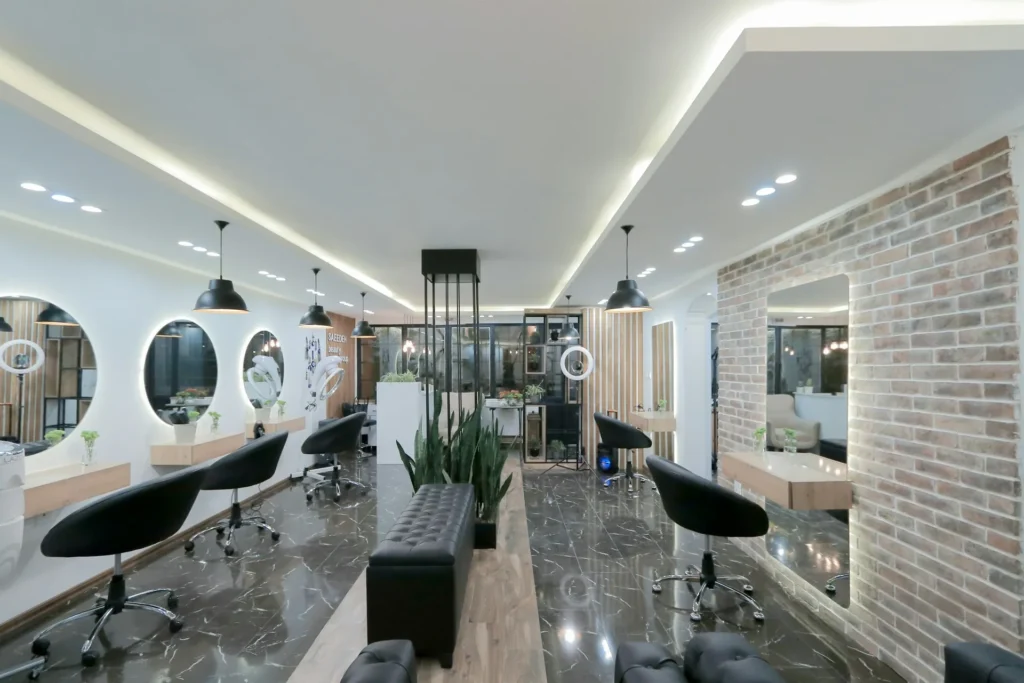
7. Design the layout
Plan zones that make the salon efficient and pleasant:
- Reception and retail at the entrance.
- Waiting area near reception.
- Styling stations with enough space between chairs for stylists to move.
- Shampoo area with comfortable bowls, ideally a little more private and relaxing.
- Color bar or dispensary for mixing color, with ventilation.
- Drying area for hooded dryers if you use them.
- Back room for laundry, storage and breaks.
Ventilation matters for color and chemical services. OSHA's page on hair salons explains hazards from some hair smoothing products and how to protect workers. Our guide to nail salon interior design covers zones, lighting and materials that apply to hair salons too.
8. Buy equipment
| Area | Equipment |
|---|---|
| Stations | Hydraulic styling chairs, station units with storage, mirrors, tool holders, outlets |
| Shampoo | Shampoo bowls and chairs, hot water capacity, towel storage |
| Color | Mixing area, scales, bowls and brushes, color storage, timers |
| Styling tools | Blow dryers, flat irons, curling irons, brushes, clips, capes |
| Drying | Hooded dryers or processors |
| Sanitation | Disinfectant, containers, labeled storage for clean tools, laundry |
| Front desk | Reception desk, POS, card terminal, retail shelving |
Buy durable chairs and shampoo units; they take daily wear and are expensive to replace. Sit in every chair and lean back in every shampoo bowl before buying, because client comfort during a long color service depends on them.
9. Choose product lines
Professional color and care brands often have distributor relationships, training and sometimes minimum orders. Consider:
- Quality and consistency of color results.
- Education offered to your team.
- Retail line that fits your clients and price point.
- Terms: minimum orders, payment terms, return policies.
Retail can add meaningful revenue if stylists recommend products naturally as part of the service. Keep the retail shelf small at first, stocked with the products your stylists actually use on clients, and track which ones sell before expanding. A tidy shelf near the front desk, with prices visible, sells far better than a crowded one in a corner.
10. Decide how to pay stylists
The main models are commission, hourly or salary plus incentives, booth rental and suite rental. Each changes who controls schedules, prices and clients, and who handles taxes. Commission gives you control and a consistent brand; booth rental gives steady rent with less control. Classification must follow the law, not the label you choose. Our article on booth rent vs commission compares the models in detail.
11. Set prices
Base prices on time, product cost, stylist pay and overhead, then compare with salons of similar quality nearby. Organize services clearly, use honest starting prices and explain stylist levels. Our guide to the hair salon price list shows how to structure and present prices.
12. Set up booking and POS
- Online booking by stylist and service, with accurate durations, deposits for long services and confirmation emails.
- POS that tracks sales by stylist, tips, retail and gift cards.
- Client records with color formulas and notes.
- Cancellation policy stated at booking.
Our article on salon booking software features lists what to look for, and Dreamer builds online booking systems for salons with booking by stylist.

Build your team
People are the product in a hair salon. Before opening, decide:
- How many stylists you need to cover opening hours without leaving chairs empty for months.
- Assistants and apprentices to shampoo, blow-dry and learn, which frees senior stylists for higher-value work.
- Front desk support for booking, checkout and phones, even part time.
- Culture: how the team treats clients and each other, how conflicts are handled, what "on time" means.
- Education: product training, technique classes and how you will pay for them.
Hire for attitude as much as technique. During interviews, ask candidates to walk you through a consultation, describe how they handle an unhappy client and show recent work with before-and-after photos. A stylist who books well, communicates clearly and supports the team is worth more to a new hair salon than a brilliant artist who clashes with everyone.
Create policies before opening
Write simple policies and share them with every new client: cancellations and late arrivals, deposits for long color services, consultation requirements, how adjustments or redos work, children in the salon and accepted payments. Clear policies protect stylists' time and reduce conflicts at checkout. Our guide to the salon cancellation policy has wording you can adapt.
Plan your hair salon brand
Your brand is how clients recognize and remember you: the salon name, logo, colors, signs, interior style, uniforms, website and social media. Choose a name that is easy to say and search, check it against existing businesses and trademarks, and secure the domain and social handles before printing anything. A consistent look, from the sign outside to the price list inside, makes even a small hair salon feel established.
13. Get insured
Common coverage for salons includes general liability, professional liability, property insurance and workers' compensation where required. Booth renters usually need their own liability coverage. Talk to an insurance agent who works with salons; our guide to nail salon insurance explains the types that apply to beauty businesses.
14. Market before and after opening
- Google Business Profile set up with photos, services and booking link before opening.
- Website with services, prices, stylists, booking and policies. Our article on hair salon website design covers the pages that matter.
- Instagram and TikTok showing transformations, the space and the team.
- Grand opening: an event, a banner and offers for first-time clients that add value rather than deep discounts.
- Referral program for clients who follow you and bring friends.
Add services that fit your hair salon
Once the core services run smoothly, consider additions that fit your clients rather than chasing every trend. Popular options include scalp treatments, bond-building and conditioning add-ons, brow shaping and tinting, makeup for events, extensions and blowout memberships. Each addition needs training, products, time in the schedule and sometimes a different license. Add one at a time, promote it to existing clients first and measure whether it raises the average ticket before adding the next.
Make the client experience your advantage
Big chains compete on price and convenience; an independent hair salon competes on experience. Small rituals make a difference: a real consultation before every service, a comfortable shampoo with a scalp massage, a drink offered on arrival, honest advice about what will and will not work for the client's hair, styling tips at the end and a follow-up message after major color. These details cost little, and they are what clients describe when they recommend your salon to friends.
Plan for slower seasons
Many salons are busiest before holidays, weddings and back-to-school, and slower in parts of January and late summer. Plan for slow weeks in advance: promote treatments and blowout packages, schedule team education, run referral campaigns and keep enough cash to cover rent and payroll when bookings dip. Looking at last year's appointment data, once you have it, shows exactly when to prepare.
15. Manage the first 90 days
- Track bookings, rebooking rates and retail sales weekly.
- Ask every client for feedback and happy clients for reviews.
- Adjust schedules to match demand.
- Hold short team meetings to fix problems early.
- Watch cash flow closely; the first months often need working capital.
Budget categories for a new hair salon
| Category | What it covers |
|---|---|
| Lease and deposits | Security deposit, first months of rent, utility deposits |
| Build-out | Plumbing for shampoo bowls, electrical, lighting, flooring, ventilation, paint |
| Equipment | Chairs, stations, shampoo units, dryers, tools, laundry |
| Licenses and fees | Establishment license, business license, permits, inspections |
| Products | Opening color inventory, back-bar products, retail stock |
| Technology | POS, card terminal, booking system, computer or tablet |
| Marketing | Website, signs, opening event, printed materials |
| Insurance | Liability, property, workers' compensation where required |
| Working capital | Cash to cover expenses until the hair salon is profitable |
Get local quotes for every line and keep a contingency for surprises such as plumbing changes or inspection fixes.
Opening day checklist
- Establishment license and inspections complete.
- Stations, shampoo bowls and dryers tested.
- Color and back-bar stock organized and labeled.
- POS, card terminal and booking tested with real appointments.
- Policies posted and on the website.
- Google profile live with photos, hours and booking link.
- Team schedule set for the first two weeks.
- Opening offer and review requests ready.
Mistakes to avoid when opening a hair salon
- Signing a lease before checking plumbing, power and zoning.
- Underestimating working capital for the first months.
- Opening without online booking, losing clients who book at night.
- Hiring too many stylists before demand exists, or too few to cover hours.
- Copying competitors' prices without knowing your own costs.
- Skipping written policies, then arguing over cancellations and redos.
Frequently asked questions
What licenses do I need to open a hair salon?
Typically a license for every stylist, a salon or establishment license, a local business license, sales tax registration if you sell retail and building permits for construction. Requirements vary by state and city.
How much does it cost to open a hair salon?
Costs depend on location, size, build-out, equipment and inventory. A business plan with local quotes for rent, construction, equipment and permits gives the most realistic number.
Can I open a hair salon without being a stylist?
In many places an owner does not need a stylist license, but everyone providing services must be licensed and the salon must hold the required establishment license. Check your state's rules.
Should I rent booths or hire employees?
It depends on how much control you want over schedules, prices and the brand. Commission or hourly employees give more control; booth rental gives steady income with less control. Follow the legal classification rules either way.
How do I get clients for a new hair salon?
A complete Google profile, a website with online booking, social media showing your work, a grand opening event, referral incentives and asking happy clients for reviews.
How long does it take to open a hair salon?
It depends on finding a location, build-out, permits and inspections. Many salons take several months from signing a lease to opening.
Knowing how to open a hair salon is about more than talent with scissors: a clear concept, a solid plan, proper licenses, a well-designed space, the right team model, fair prices and systems that keep chairs full. Plan carefully, open with a strong online presence and focus on rebooking and reviews in the first months. If you want a website with booking by stylist ready for opening day, Dreamer's website design team builds sites for salons across the US.
No time to do this yourself? We can do it for you.
Send your business name and ZIP code. We review your Google Maps, Yelp and Facebook presence and call you back for free.