Knowing how to price nail services is the difference between a salon that is busy and profitable and one that is busy and exhausted. Many owners set prices by looking at the salon down the street and charging a little less. That feels safe, but the salon down the street has different rent, different pay arrangements and maybe a different idea of what a gel manicure includes. If your costs are higher, matching their prices means losing money on every chair you fill.
This guide gives you a seven-step method and a formula that turns your real costs into prices. The example numbers are illustrations to show the math; your own product costs, rent and pay structure will produce your own answers. Once the numbers are set, we cover add-ons, nail art, fills, technician levels and how to present prices so clients understand them.
In this article
- Why copying competitors' prices fails
- Step 1: Calculate product cost per service
- Step 2: Calculate overhead per chair hour
- Step 3: Time each service honestly
- Step 4: Add technician pay, card fees and profit
- Step 5: Use the formula
- Step 6: Check the market and your position
- Step 7: Build a clear price structure
- How to price nail art
- Pricing fills, removals and repairs
- Which services earn the most per hour
- Pricing a new service
- Discounts, packages and memberships
- Tips are not part of the price
- Talking about prices with clients
- Show prices clearly everywhere
- Review prices every year
- Mistakes to avoid
- How Dreamer helps
- Frequently asked questions
Why copying competitors' prices fails
Competitor prices are useful information, but they are a poor starting point. You do not know their costs, their profit, or whether they are quietly struggling. Two salons can charge the same for a pedicure while one makes a healthy profit and the other loses money because its rent is higher or its service takes twenty minutes longer. Start from your own costs, then use the market to check your position.
Step 1: Calculate product cost per service
For each service, add up what you use: polish or gel, base and top coat, acrylic or dip powder, tips, files and buffers, cotton, gloves, liners, towels, lotion, scrub and any single-use tools. Product cost per service is usually smaller than owners fear, but it varies a lot by service: a basic polish change uses little, while a full set with art and a deluxe pedicure with masks and paraffin use much more.
A practical way to estimate: divide the price of each product by the number of services it typically lasts, then add the items used per service. Do this once carefully and update it when supplier prices change.
Step 2: Calculate overhead per chair hour
Overhead is everything you pay to keep the doors open, whatever the number of clients: rent and shared costs, utilities, insurance, software, front desk wages, cleaning, laundry, marketing, accounting and loan payments. Add these up for a month.
Then estimate your productive chair hours per month, the hours technicians actually spend doing services:
Productive hours = stations × open hours per day × days open per month × share of time busy
Divide monthly overhead by productive hours to get overhead per chair hour. With illustrative numbers: overhead of $9,000 per month and 6 stations × 8 hours × 26 days × 60% busy, about 750 productive hours, gives roughly $12 of overhead for every hour of service.
Step 3: Time each service honestly
Use real times, including setup, consultation, cleanup and disinfection between clients, not the fastest time your best technician has ever achieved. A gel manicure that takes 35 minutes of work may occupy the station for 45 minutes. Time is the hidden cost in pricing: a service that takes twice as long must earn twice as much overhead.
| Service | Time in the chair, including cleanup |
|---|---|
| Polish change | |
| Classic manicure | |
| Gel manicure | |
| Classic pedicure | |
| Deluxe pedicure | |
| Full set, acrylic or structured gel | |
| Fill | |
| Removal |
Fill in the table with averages from your own salon, timed over a normal week.
Step 4: Add technician pay, card fees and profit
Technician pay is usually the largest cost per service. If technicians earn a commission, it is a percentage of the price; if they earn hourly wages, convert wages and payroll taxes into a cost per hour. Card processing fees are also a percentage of the price; our guide to credit card processing fees for salons explains how they work. Finally, decide on a target profit margin, the share of each price that stays with the business after all costs.
Step 5: Use the formula
When pay, card fees and profit are percentages of the price, this formula gives the price that covers everything:
Price = (product cost + overhead per hour × hours) ÷ (1 − commission rate − card fee rate − profit margin)
Worked example with illustrative numbers for a gel manicure:
- Product cost: $3
- Time in the chair: 45 minutes, or 0.75 hour
- Overhead: $12 per hour × 0.75 = $9
- Commission: 50%
- Card fees: 3%
- Target profit: 12%
Price = ($3 + $9) ÷ (1 − 0.50 − 0.03 − 0.12) = $12 ÷ 0.35 ≈ $34.30, which you might round to $35.
Check the result: at $35, the technician earns $17.50, card fees are about $1.05, product costs $3 and overhead $9, leaving about $4.45, close to 13% profit. If the result is far above what your market accepts, the formula has shown you something important: you need to lower costs, shorten the service, change the pay structure or position the salon for clients who value a premium experience.
A pricing worksheet for every service
Repeat the calculation for each service on your menu. A simple worksheet keeps the numbers in one place and makes yearly reviews quick:
| Service | Minutes | Product cost | Overhead | Commission | Card fees | Profit | Price |
|---|---|---|---|---|---|---|---|
| Gel manicure (example) | 45 | $3.00 | $9.00 | 50% | 3% | 12% | $35 |
| Classic pedicure | |||||||
| Deluxe pedicure | |||||||
| Full set | |||||||
| Fill |
When you price nail services this way, every number has a reason, and you can explain any price to a partner, a lender or a technician who asks.
What if the formula gives a price that seems too high?
That result is valuable, because it shows the problem before it costs you money. Look at each part of the formula. Can the service take less time with better preparation and organized stations? Is product being wasted? Are you paying for overhead the salon does not need? Is the salon too empty, so each busy hour carries too much rent? Filling quiet hours through online booking, Google and social media lowers overhead per hour more than any cost cutting; Dreamer's Social Marketing focuses on exactly that. If none of these change enough, position the salon for clients who value a premium experience, or remove services that cannot be priced profitably.
Step 6: Check the market and your position
Now compare your calculated prices with nearby salons. Look at three to five competitors that serve the same clients, and note what each service includes, not just the price. Decide where you want to be:
- Value: lower prices, efficient service, high volume. Works only if costs are low and the salon stays busy.
- Mid-range: fair prices, consistent quality, a comfortable salon. Where most salons compete.
- Premium: higher prices for longer services, better products, a calmer atmosphere and skilled art.
If your calculated price is higher than competitors, make the difference visible: better hygiene, longer massage, premium products, online booking, nail art skills, a cleaner and calmer space. Clients pay more when they can see why.
Step 7: Build a clear price structure
Good pricing is easy to understand. These structures work well for nail services:
Base services plus add-ons
Keep base services simple and let clients add what they want: gel upgrade, French tips, chrome, paraffin, extra massage time, callus treatment. Add-ons raise the average ticket without making the menu confusing, and technicians can suggest them naturally.
Good, better, best
Offer pedicures and manicures in three levels, for example a classic, a deluxe with scrub and mask, and a signature with paraffin and a longer massage. Most clients choose the middle option, and the top option makes it look like good value.
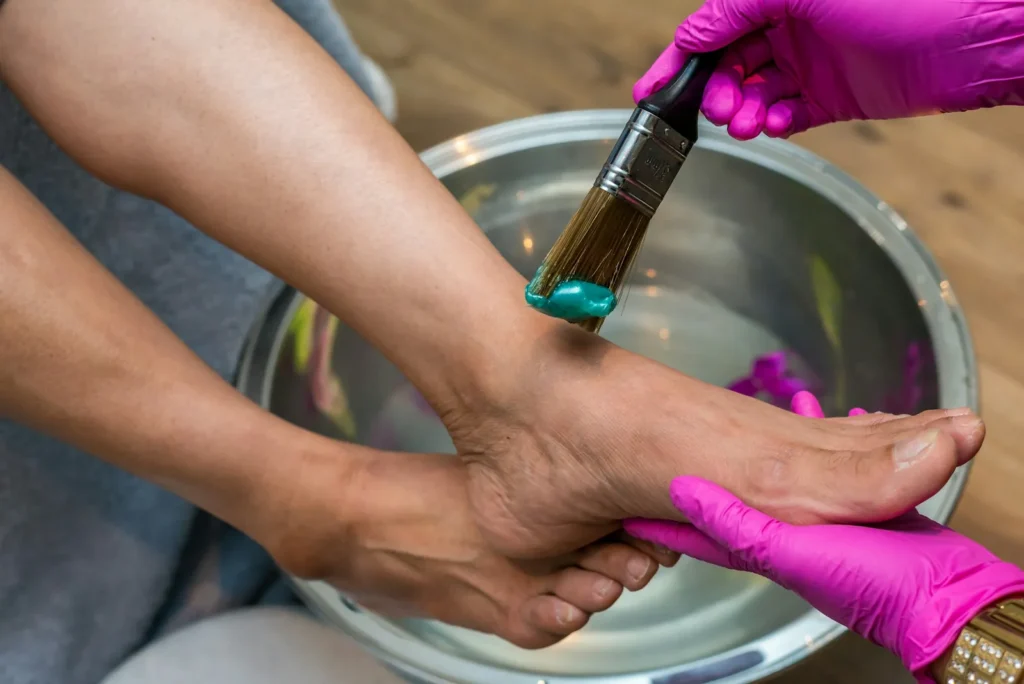
"From" prices for variable work
For services that vary with length, shape or design, show a starting price: "Full set from $X". Explain what changes the price, such as extra length, special shapes or art, and confirm the total before starting. Clients accept variable prices when they hear them before the service, not at the register.
Technician levels
Some salons charge more for senior or master technicians whose time is in higher demand. This rewards skill, helps balance bookings and gives newer technicians a path to grow. Explain the levels clearly in the menu and the booking system.
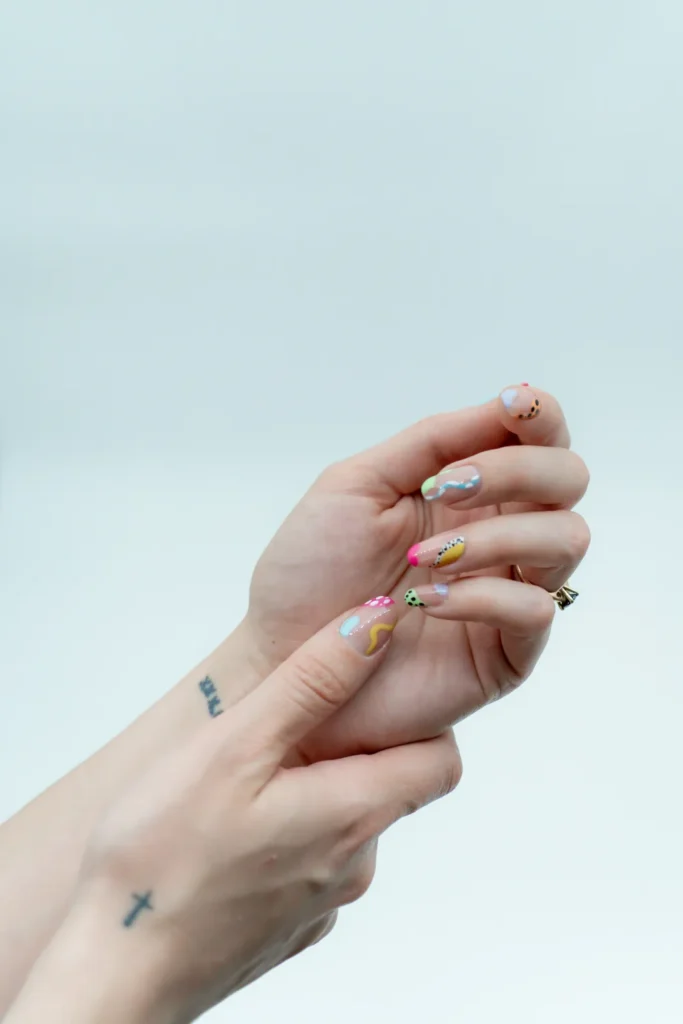
How to price nail art
Nail art ranges from a single accent nail to hand-painted designs on all ten nails. Common approaches:
- Per nail, for simple designs such as a stamp, a dot or a small decal.
- Tiers, such as simple, detailed and complex, with a price range for each and examples in a photo book or on your Instagram.
- Time-based, for custom work, using your overhead and pay per hour to set a rate for art time.
Whatever you choose, show photos of each tier so clients know what they are buying, and confirm the art price before starting.
Pricing fills, removals and repairs
Fills keep clients coming back, so price them to be fair and sustainable. Many salons set a fill window, for example two or three weeks, after which a fill is priced closer to a new set because there is more work. Removal of another salon's product often takes longer than removing your own; a separate removal price prevents surprises. Decide your repair policy too: a free fix within a few days for a lifted or broken nail builds trust, while repairs after that time are charged per nail.
Which services earn the most per hour
Price alone does not tell you which services are best for the salon. Divide the profit of each service by the hours it occupies the station to get profit per chair hour. A quick gel polish change may earn more per hour than a long pedicure with a low price, and a full set with art may earn the most of all when it is priced correctly. Knowing these numbers helps you decide which services to promote in your posts, which to put first on the menu and which slow, low-profit services to reprice or simplify.
Pricing a new service
When you add a service, such as structured gel or a new pedicure, time it on several clients before setting the final price, and calculate product cost from real use, not from the supplier's estimate. Some salons offer a short introductory price while technicians learn the technique, clearly labeled with an end date. Once the times are steady, apply the formula and publish the regular price.
Discounts, packages and memberships
Discounts are easy to give and hard to take back. Instead of lowering prices, consider adding value: a free paraffin with a pedicure on weekdays, a bundle for a manicure and pedicure together, or a prepaid package of visits. Memberships with a monthly fee can smooth income and reward loyal clients, but price them so the salon still earns its margin. If you consider a cash discount, follow card network rules and state law; our article on cash discount vs surcharge explains the difference.
Tips are not part of the price
Do not lower prices on the assumption that tips will make up the technician's pay. Tips belong to the client's choice and, for employees, follow federal and state rules on who keeps them. Price services so the technician's pay is fair before any tip.
Talking about prices with clients
Most price complaints come from surprises, not from the price itself. Train technicians to confirm any extra before starting: "This design with chrome on all ten nails is $X more, so your total will be $Y. Is that okay?" Say it calmly, as information rather than an apology. When a client asks why your salon costs more than another, explain what is included, such as single-use files, sterilized tools, a longer massage or premium gel, instead of offering a discount.
Show prices clearly everywhere
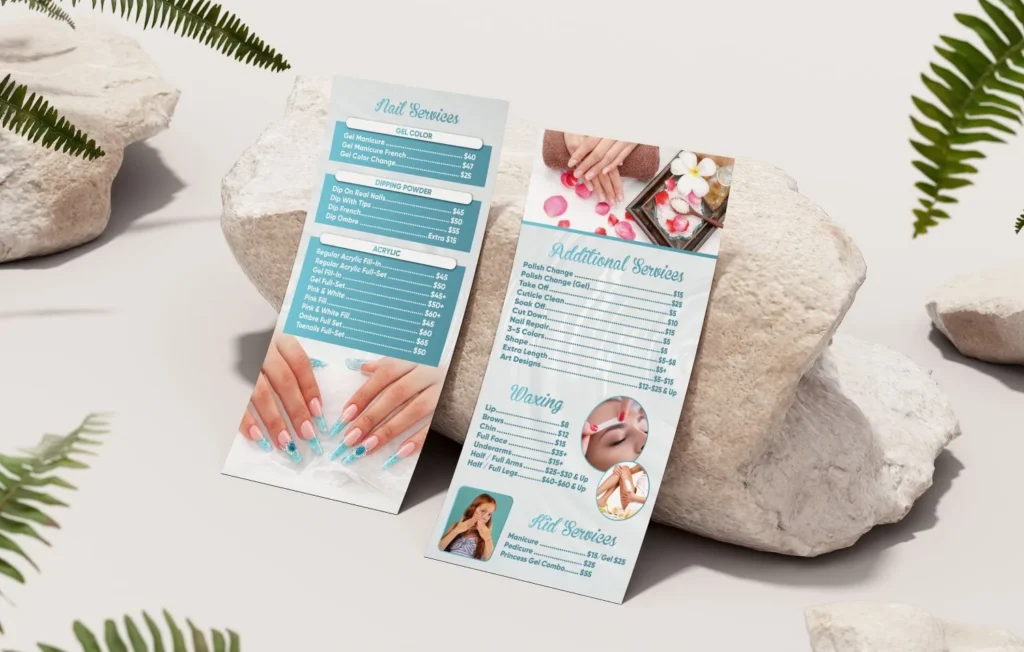
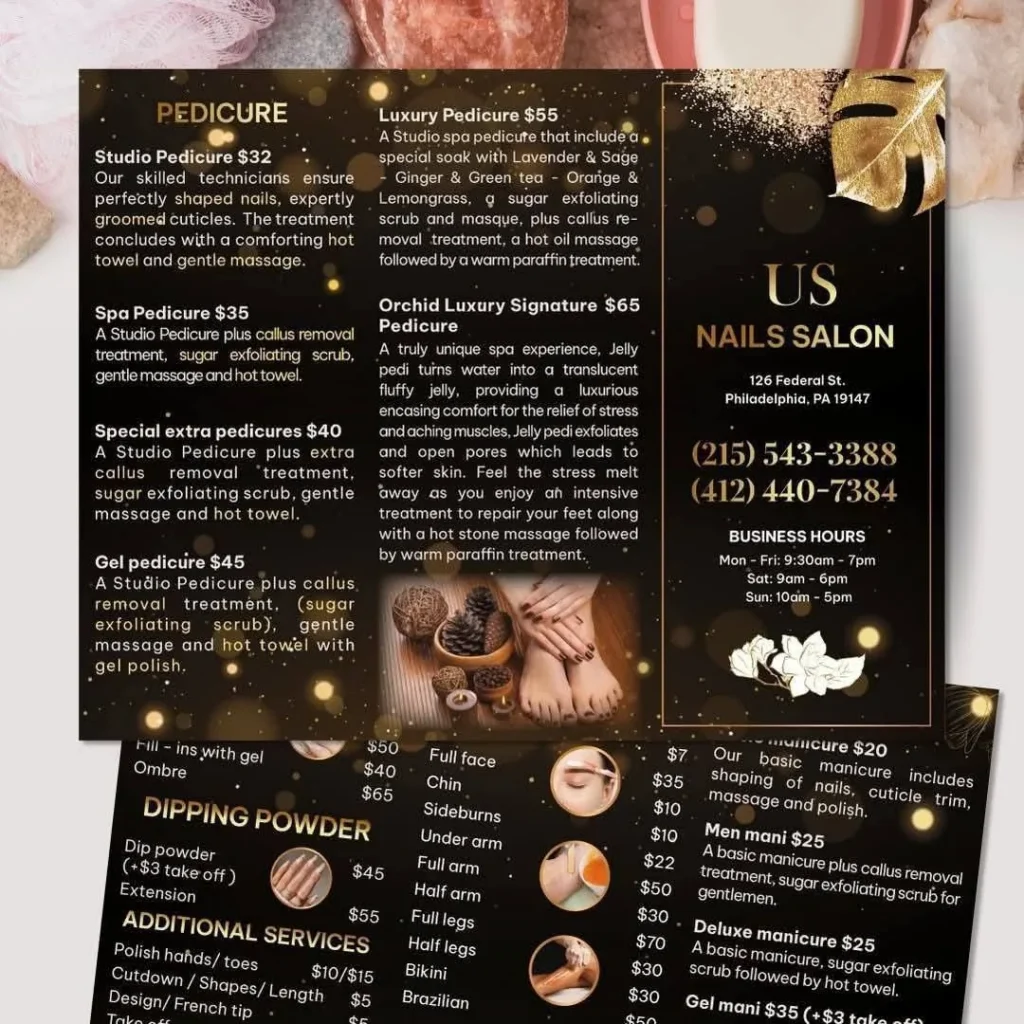
Once prices are set, show them the same way on your wall menu, website, booking system and Google Business Profile. Clear prices reduce awkward conversations at the front desk and make clients more comfortable adding extras. Our guide to nail salon menu design explains how to present services, levels and add-ons, and Dreamer can design and print a wall menu that matches your website.
Review prices every year
Costs rise every year: rent, products, wages and card fees. Review your prices at least once a year using the same formula, and compare your increases with general inflation; the Bureau of Labor Statistics publishes the Consumer Price Index every month. Small, regular increases are easier for clients to accept than a big jump after years of no change. Our guide on how to raise prices at a nail salon explains how to announce and explain a change.

Mistakes to avoid
- Pricing below cost to compete with a cheaper salon.
- Ignoring time, so long services earn the same as short ones.
- Forgetting card fees and payroll taxes.
- Too many options that confuse clients and staff.
- Surprise charges at checkout for art, length or removal.
- Never reviewing prices for years, then raising them sharply.
- Different prices on the wall, the website and the booking system.
How Dreamer helps
Dreamer helps salons present their prices clearly and consistently: printed wall menus and price lists through our design and printing service, websites with service menus and online booking through website design, and Google Business Profile services lists kept up to date through Social Marketing. When you change prices, we update the menu, website and profile together.
Frequently asked questions
How do I calculate the price of a nail service?
Add product cost and overhead for the service time, then divide by one minus your commission rate, card fee rate and target profit margin. Round to a clean number and check it against the market.
Should I charge the same as other salons nearby?
Use them as a reference, not a rule. Your costs and services may be different. If your price is higher, make the extra value visible.
How should I price nail art?
Per nail for simple designs, by tier for most art, and by time for custom work. Show examples and confirm the price before starting.
How often should salons raise prices?
Review prices every year. Small, regular increases are easier for clients to accept than large, rare ones.
Do tips count toward the price?
No. Set prices so technicians are paid fairly before tips, and follow the rules on tips for employees.
Should senior technicians charge more?
It can work well, if the levels are clear on the menu and in the booking system and reflect real differences in skill and demand.
Learning how to price nail services is learning your own numbers: product cost, overhead per chair hour, time, pay, card fees and profit. Use the formula, check the market, build a structure clients understand and review it every year. Prices built this way let you pay your team well, keep the salon in good shape and stay busy for the right reasons.