In this article26 sections
Vinyl banner sizes are the first decision when ordering a banner, and often the one people guess. Order too small and the banner disappears on a wide storefront or a busy road. Order too large and it will not fit the space, will flap in the wind or may break your city's sign rules. The right size depends on where the banner hangs, how far away people will read it, what it needs to say and how long it will stay up.
This guide helps you choose the right vinyl banner for your business: common sizes and where they fit, how to size for viewing distance, letter height, how much text a size can hold, materials and weights, mesh versus solid vinyl, hems and grommets, installation, wind, permits for temporary signs, design tips by size and file setup. Examples come from nail salons, restaurants, bakeries, markets and shops.
Common vinyl banner sizes and where they fit
| Size | Typical use | Notes |
|---|---|---|
| 2 × 4 ft | Indoor counters, small walls, event tables | Readable up close |
| 2 × 6 ft | Narrow storefront fascias, table fronts | Good for a name and short message |
| 3 × 6 ft | Storefront windows and walls, event booths | Popular all-purpose size |
| 3 × 8 ft | Storefront fascias, grand openings | Strong visibility from the parking lot |
| 3 × 10 ft | Wide storefronts, fences | Room for a headline and phone or website |
| 4 × 8 ft | Building walls, fences facing roads | Readable from farther away |
| 4 × 10 ft and larger | Large buildings, roadside fences, big events | Needs secure mounting and often mesh |
These are common starting points; custom sizes are easy to order. Measure the exact space where the banner will hang before choosing.
1. Measure the space first
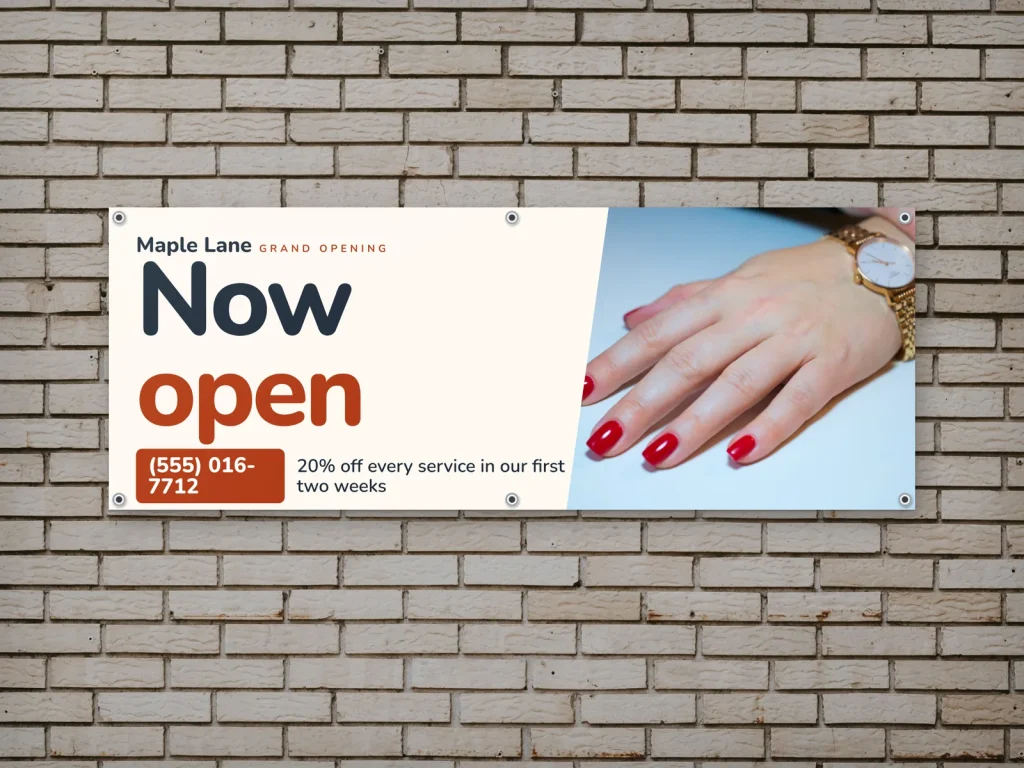
Measure the wall, fascia, fence section or booth frame where the banner will go, including where you can attach it. Take a photo of the space with the tape measure visible; it helps your designer choose proportions and shows the printer exactly where grommets are needed. Leave margins around the banner so it does not cover windows, signs, vents or lights, and check that it will not block another business's sign in a shopping center. A banner that fits the space neatly looks professional; one that is squeezed or overlaps edges looks improvised.
2. Size for viewing distance
The farther away people read the banner, the larger it and its letters must be. A banner seen by pedestrians at the door can be smaller than one meant for drivers on a road across the parking lot. Stand where your audience will be, look at the location and imagine the banner there. If people will read from a moving car, choose a larger size and fewer words.
3. Use letter height as a guide
A common signage rule of thumb is roughly one inch of letter height for every ten feet of viewing distance for basic legibility, with larger letters for quick reading or drivers:
| Reading distance | Minimum letter height (rule of thumb) | Better for quick reading |
|---|---|---|
| 10 ft | About 1 in | 2 to 3 in |
| 50 ft | About 5 in | 8 to 10 in |
| 100 ft | About 10 in | 15 in or more |
Use these as a starting point, then check your design at full size. The banner size follows from the letter height you need and how many words you want.
4. Decide how much text the size can hold
A 3 × 6 ft banner can carry a headline of a few words, your name or logo and one more line such as a phone number or website. Longer messages need bigger banners or fewer words. As a simple rule:
- Headline: three to seven words.
- Supporting line: one short line.
- Contact: a short website or phone, only if readable at the distance.
If you need to say more, use a second banner or move details to flyers and your website.
5. Choose the right material weight
- Standard 13 oz vinyl: a common, affordable choice for most indoor and outdoor uses.
- Heavier vinyl (15 oz and up): more durable for long outdoor use and larger sizes.
- Blockout vinyl: prevents light from showing through; needed for double-sided banners.
- Matte or gloss: matte reduces glare in sun or under lights; gloss makes colors pop.
Dreamer prints vinyl banners in common and custom sizes, with grommets and hems, ready to hang indoors or outdoors.
6. Mesh or solid vinyl?
Mesh banners have tiny holes that let wind pass through. They are ideal for fences, scaffolding and large outdoor banners in windy places, because they reduce wind load and flapping. Solid vinyl shows colors more vividly and works better for walls, indoor use and smaller sizes. For a fence facing a road, mesh is often the safer choice; for a storefront fascia, solid vinyl usually looks best.
7. Choose finishing: hems, grommets and pole pockets
- Hemmed edges reinforce the banner and prevent tearing.
- Grommets (metal rings) every couple of feet along the edges, for ropes, bungees or zip ties.
- Pole pockets for hanging on poles or frames.
- Extra grommets for large banners or windy locations.
Tell your printer how the banner will be mounted so they add the right finishing.
8. Install it safely
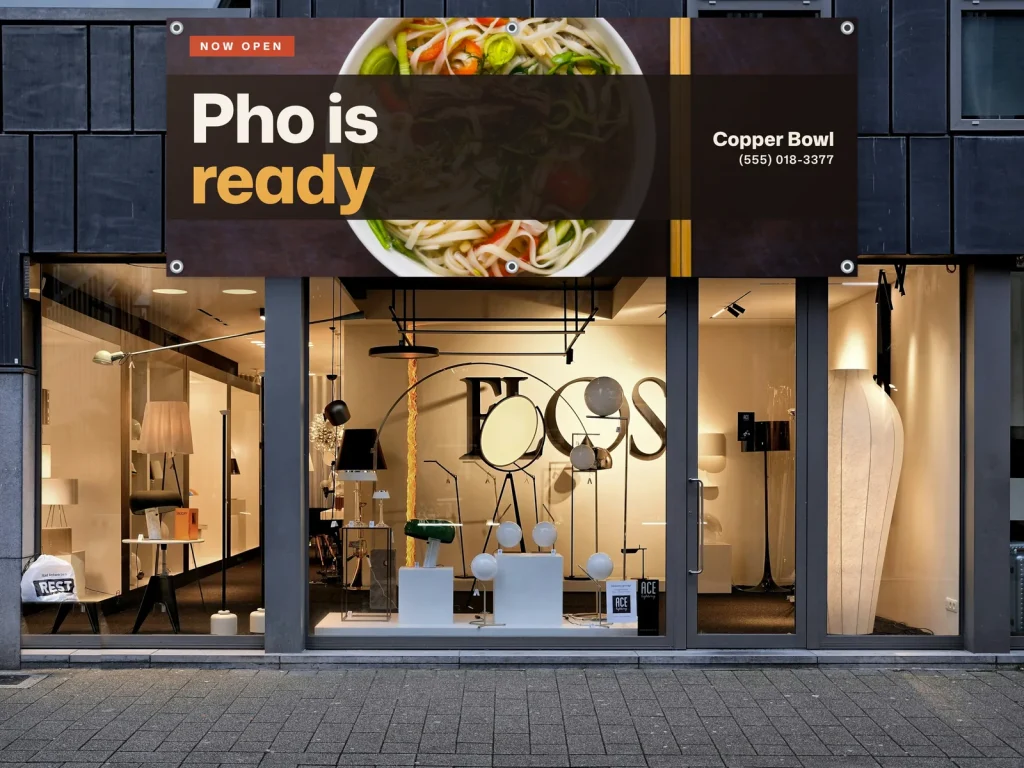
- Use bungee cords or ball bungees on fences so the banner can flex slightly in wind.
- Use zip ties or screws with washers on walls where allowed.
- Pull the banner taut evenly so it does not sag or flap.
- Check it after storms and tighten fittings.
- Never block exits, windows required for egress or traffic sightlines.
For high installations, use proper ladders or hire a sign installer.
9. Know the rules for temporary banners
Many cities regulate temporary banners: how large they can be, how many you can display, how long they can stay up and whether you need a permit. Shopping centers and landlords often have their own rules. Check with your city's planning or permit office and your lease. The SBA's guide to licenses and permits explains that many signage permits are handled locally.
10. Design tips by size
- Small banners (2 × 4 to 2 × 6 ft): name or logo plus one message; ideal for indoor counters and event tables.
- Medium banners (3 × 6 to 3 × 8 ft): headline, logo and one supporting line; the workhorse size for storefronts and openings.
- Large banners (3 × 10 ft and up): bold headline readable from the road, logo, short website; avoid small text entirely.
In every size, use high contrast, bold fonts and plenty of space around words. Put the most important words in the center, where they are seen first.
11. Set up files correctly
- Design at the final proportions (for example, 3:8 for a 3 × 8 ft banner).
- Use vector logos and text for sharp edges.
- Use high-resolution photos; large banners are viewed from a distance, so they need less resolution per inch than small prints, but low-quality images still look blurry.
- Leave a safe margin around edges for hems and grommets.
- Check the proof at a scale that represents the real distance.
12. Plan banners by purpose
| Purpose | Suggested size | Message example |
|---|---|---|
| Grand opening | 3 × 8 or 3 × 10 ft | "Grand Opening · Now Open · Walk-ins Welcome" |
| Now hiring | 2 × 6 or 3 × 6 ft | "Now Hiring Nail Technicians · Apply Inside" |
| Lunch special | 3 × 6 ft | "Lunch Special 11 to 3 · Pho + Drink" |
| Event booth | 2 × 6 ft table front, 3 × 6 ft backdrop | Logo and one line about what you sell |
| Seasonal pre-orders | 3 × 8 ft | "Order Lunar New Year Cakes Now" |
| Fence facing a road | 4 × 8 ft mesh | Name, one service, short website |
Vinyl banner sizes for storefronts
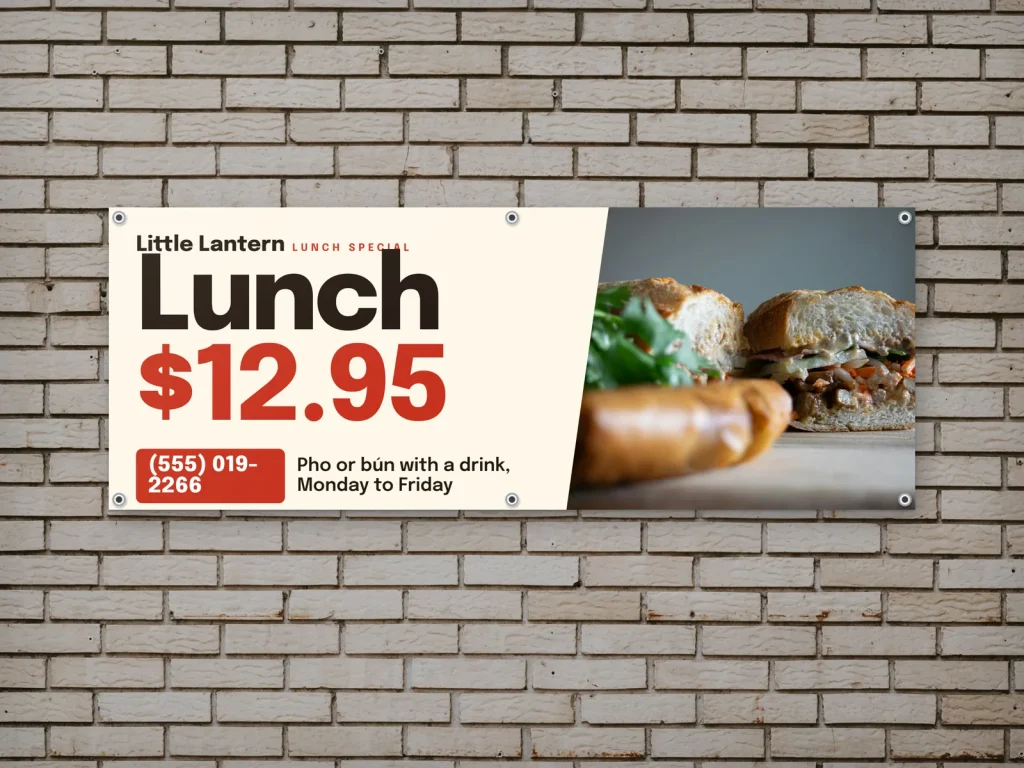
For a storefront, start from the width of the fascia or the wall between windows. A vinyl banner usually looks best when it fills most of that width with a margin on each side, rather than a small rectangle lost in a large wall. Common storefront choices are 2 × 6 ft for narrow shops, 3 × 8 ft for typical plaza units and 3 × 10 ft for wide frontages. If your permanent sign is still being made, a vinyl banner with your name and "Now Open" is an inexpensive temporary sign that people can read from the parking lot.
Vinyl banner sizes for events and markets
At events, think about two banners: a table banner around 2 × 6 ft that hangs on the front of your table, and a backdrop or upright banner around 3 × 6 ft behind you, high enough to be seen over people standing in front of the booth. Check the event's rules for booth size, height limits and how banners may be attached. A consistent set of event banners, with the same logo and colors, makes your booth easy to find at every market.
Vinyl banner sizes for fences and roadsides
Fences facing a road need larger banners, often 4 × 8 ft or more, with bold letters and very few words, because drivers pass quickly. Mesh vinyl is usually the better material here. Attach the banner at many points along the fence so it cannot sag or tear in wind, and make sure it does not block visibility for drivers at intersections or driveways.
Indoor vinyl banners
Indoors, smaller vinyl banner sizes work well: behind a reception desk, above a retail shelf, in a waiting area or at a cashier counter. Indoor banners are read from a few feet away, so text can be smaller and you can include more detail, such as a short service list or a QR code to book or order. Matte material avoids glare under bright ceiling lights.
How size affects cost
Banner prices generally rise with size and with options such as heavier material, mesh, double-sided printing and extra finishing. Bigger is not always better: a medium vinyl banner with a clear message in the right place often outperforms a huge banner with crowded text. Decide the purpose, the reading distance and the space first, then choose the smallest size that does the job well.
Ordering checklist
- Exact space measured, with margins.
- Reading distance and audience (walkers or drivers) known.
- Letter height checked for that distance.
- Material chosen: solid, mesh or blockout.
- Finishing chosen: hems, grommets, pole pockets.
- Local rules and landlord approval checked.
- Proof reviewed at a realistic scale.
Vinyl banners and other signs
Banners work best as part of a set: a vinyl banner for big announcements, an A-frame sign for daily messages, window graphics for hours and services and a roll-up banner for events. Keep the same colors, fonts and logo across all of them. Our guides to A-frame sign ideas, roll-up banner design and yard signs for business cover the other pieces.
Double-sided and hanging banners
A banner hung from a ceiling, across a walkway or perpendicular to a storefront can be seen from both directions. For these uses, order a double-sided vinyl banner with blockout material, so the image on one side does not show through to the other. Hanging banners need reinforced top and bottom edges or pole pockets, and sometimes a weighted bottom pole to keep them straight. They are great for markets, festivals, indoor events and plazas where people approach from several directions.
Photos and colors on large banners
A big vinyl banner makes photos and colors larger than life, which is powerful when the photo is good and unforgiving when it is not. Choose one strong photo of your product, food or work with simple composition, avoid busy backgrounds and keep text away from the most detailed parts of the image. Bright, saturated brand colors read well outdoors, while pale pastels can wash out in sunlight. If your brand palette is soft, use its darkest color for text and add a solid panel behind the headline.
How long vinyl banners last
Outdoor banners face sun, rain and wind. Heavier materials, UV-resistant inks, proper finishing and secure mounting help them last longer. Take temporary banners down when the promotion ends, store them rolled (not folded) and replace any banner that is faded or torn; a worn banner sends the wrong message about your business.
Reusing vinyl banners
Many vinyl banners can be used again and again if the message is evergreen: your name and "Walk-ins Welcome", "Now Hiring" or "Catering Available". Order evergreen banners in durable material, store them rolled with the printed side out in a dry place and clean them gently with mild soap and water before rolling. Keep a list of the banners you own with their sizes, so you know what is available before ordering new ones for the next season or event.
Common mistakes
- Guessing the size without measuring the space.
- Too much text for the size and distance.
- Solid vinyl on a windy fence that tears or pulls loose.
- Not enough grommets on large banners.
- Ignoring city rules for temporary signs.
- Low-contrast colors that disappear from a distance.
Frequently asked questions
What is the most common vinyl banner size?
3 × 6 ft is a popular all-purpose size for storefronts and events; 3 × 8 ft and 3 × 10 ft are common for grand openings and wide storefronts.
How big should the letters on my banner be?
A common rule of thumb is about one inch of letter height per ten feet of viewing distance for basic legibility, and larger for drivers or quick reading.
Should I choose mesh or solid vinyl?
Mesh is better for fences and windy outdoor locations because wind passes through; solid vinyl looks brighter on walls and indoors.
How many grommets does a banner need?
Typically grommets every couple of feet along the edges, with extra grommets for large banners or windy places.
Do I need a permit to hang a banner?
Many cities regulate temporary banners by size, number and duration, and some require permits. Check with your city and landlord.
How do I hang a vinyl banner on a fence?
Use bungee cords or ball bungees through the grommets, pull the banner taut evenly and check it after storms.
Choosing vinyl banner sizes is about the space, the distance and the message: measure first, size letters for your audience, keep words few, pick the right material and finishing and follow local rules. Do that and your banner will be read, remembered and acted on. If you want a banner designed and printed to fit your storefront or event, Dreamer's design and printing team prints for salons, restaurants and shops across the US.
No time to do this yourself? We can do it for you.
Send your business name and ZIP code. We review your Google Maps, Yelp and Facebook presence and call you back for free.