Restaurant menu design is one of the few marketing tools every single guest reads. Before they order, guests scan your menu looking for something familiar, something special and something that fits their budget. A clear, well-organized menu helps them decide quickly, highlights the dishes you are proudest of and makes the kitchen's job easier. A cluttered menu with tiny type, unexplained names and prices scattered everywhere slows ordering, frustrates guests and hides your best food.
This guide covers menu design for small restaurants, pho and noodle shops, banh mi counters, bubble tea stores, bakeries and cafés: organizing sections, naming dishes in two languages, writing descriptions, showing prices, highlighting signatures, using photos honestly, choosing formats and materials, handling allergens and keeping the printed, online and delivery menus consistent.
In this article
- What a good menu does
- Organize sections the way guests order
- Name dishes in two languages
- Write descriptions that sell
- Show prices clearly
- Highlight signatures and best sellers
- Photos: helpful, not cluttered
- Allergens and dietary information
- Formats and materials
- Drinks and desserts deserve space
- Spice levels and customizations
- Readability first
- Keep every menu in sync
- Specials and seasonal dishes
- Layout patterns that work
- Counter menus for quick service
- Takeout and delivery menus
- Catering menus
- Kids' menus and family options
- Menus for different kinds of restaurants
- Pricing with your costs in mind
- QR code menus done right
- Training staff on a new menu
- Brand consistency from door to table
- Menus for guests who read slowly or not at all
- Menus and online ordering together
- Holiday and event menus
- Measure what changes
- Proofreading and testing
- Mistakes to avoid
- How Dreamer helps restaurants
- Frequently asked questions
What a good menu does
- Helps guests decide fast, especially at a busy counter.
- Introduces unfamiliar dishes with clear descriptions.
- Highlights signatures and profitable items.
- Reflects your brand, from casual noodle shop to refined bistro.
- Reduces mistakes with clear options and modifiers.
Organize sections the way guests order
| Section | Examples |
|---|---|
| Starters | Spring rolls, fresh rolls, wings |
| Signature dishes | House pho, bun bo Hue, seafood boil combos |
| Noodle soups | Pho by protein, broth options |
| Rice and vermicelli plates | Com tam, bun cha |
| Sandwiches | Banh mi by filling |
| Vegetarian | Tofu and vegetable dishes |
| Drinks | Vietnamese coffee, teas, smoothies, boba |
| Desserts | Che, flan, pastries |
Keep the number of sections manageable and put the most popular sections where eyes land first: the top of the first page, or the center of a single-page menu.
Name dishes in two languages
For Vietnamese and other Asian restaurants, two-language names help everyone:
- Original name first, for guests who know it: "Bun Bo Hue".
- English description below: "Spicy beef noodle soup with lemongrass, sliced beef and pork."
- Consistent spelling with or without diacritics across print, website and delivery apps.
- Numbers next to dishes help guests who are unsure how to pronounce names and speed up ordering.
Write descriptions that sell
Descriptions turn a list into an invitation:
- Mention the main ingredients and how the dish is cooked.
- Use specific words guests can taste: "charcoal-grilled", "simmered overnight", "crispy", "fresh herbs".
- Keep it to one or two lines.
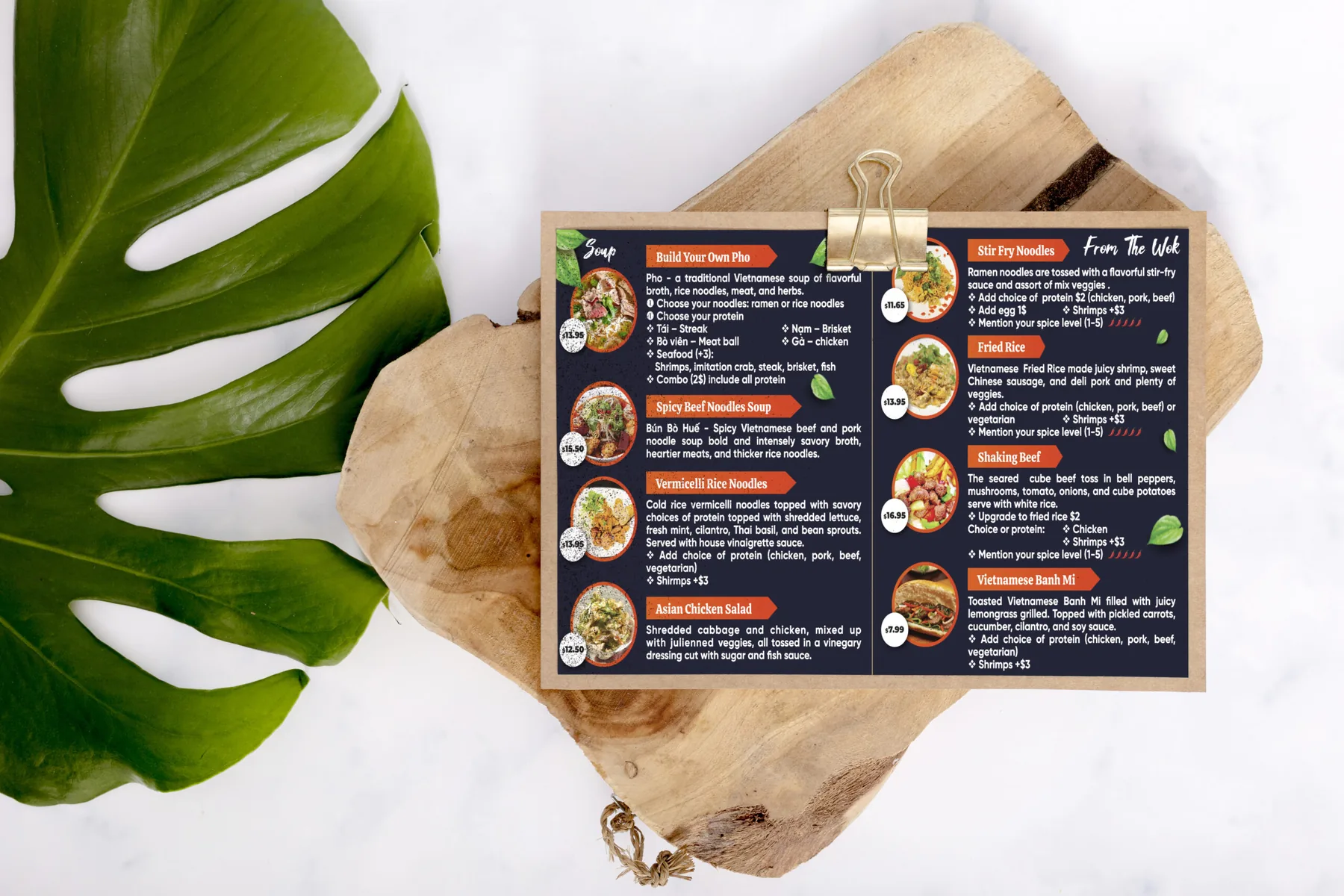
- Note spice levels clearly, with a simple icon or words.
- Avoid empty words such as "delicious" or "amazing".
Example: "Pho Dac Biet: our house special with rare steak, brisket, tendon and meatballs in a beef broth simmered for twelve hours."
Show prices clearly
- Align prices in a consistent position for easy scanning.
- Show size options on one line: "Small 14 · Large 16".
- List add-ons with prices: extra meat, extra noodles, egg.
- Avoid scattering surcharges in fine print.
- Update prices on every menu at the same time.
Some restaurants drop dollar signs or align prices differently for style; whatever you choose, keep it consistent and easy to read.
Highlight signatures and best sellers
Guests often decide in seconds. Help them notice what matters:
- A box or colored panel around two or three signature dishes.
- A small "House favorite" or "Chef's pick" label.
- A photo of the signature dish, if you use photos.
- Placement near the top of the first page or the center of a single page.
Highlight dishes you are proud of and that make good business sense. The idea of reviewing which dishes are popular and profitable, sometimes called menu engineering, can guide what you highlight and what you remove.
Photos: helpful, not cluttered
Photos help guests understand unfamiliar dishes, but too many make a menu look crowded:
- Use real photos of your own dishes, taken in good light.
- Limit photos to signatures and dishes guests may not know.
- Keep photo style consistent.
- Make sure the photo matches what the guest receives.
Allergens and dietary information
Guests ask about allergens, vegetarian options and spice levels every day:
- Mark vegetarian, vegan and gluten-free options you can stand behind.
- Note common allergens such as peanuts, shellfish, fish, sesame, wheat, soy, eggs, milk and tree nuts.
- Add a short line inviting guests with allergies to speak to staff.
Larger chains have additional rules: the FDA's menu labeling requirements require restaurants that are part of a chain with 20 or more locations to show calories on menus and menu boards, with written nutrition information available on request.
Formats and materials
| Format | Best for |
|---|---|
| Plastic or laminated menus | Busy family restaurants and pho shops; wipeable and durable |
| Leather-cover menu books | Sit-down bistros and dinner service |
| Wall or board menus | Counter service: banh mi, bubble tea, bakeries |
| Takeout menus | Home delivery orders and catering |
| Table tents and inserts | Specials and seasonal dishes |
| QR code menus | Always current, readable on phones |
Dreamer prints laminated menus, flexible plastic menu pages, leather-cover menu books and wall menus for restaurants and cafés.
Drinks and desserts deserve space
Drinks and desserts are often the easiest additions to an order, yet many menus squeeze them into a corner. Give them a clear section with short, tempting descriptions: "Vietnamese iced coffee, dark roast through a phin, sweet condensed milk"; "Che ba mau, three-color dessert with beans, jelly and coconut milk". A small photo of one signature drink or dessert can lift sales noticeably, and servers can point to it when guests hesitate. If you make drinks with many options, list the choices once at the top of the section instead of repeating them for every item.
Spice levels and customizations
Many Asian dishes can be adjusted: spice level, broth, noodles, protein, herbs on the side. Explain the options once, clearly, and use the same words on the POS and kitchen tickets. A simple scale, such as mild, medium, hot and extra hot, prevents misunderstandings and sends fewer dishes back to the kitchen.
Readability first
- Use a readable font size; many guests read menus without their glasses in dim light.
- Keep strong contrast between text and background.
- Use one or two fonts.
- Leave white space between sections.
- Test in your real lighting at dinner time.
Keep every menu in sync
Guests compare your printed menu with your website, Google profile and delivery apps. Keep one master list of dishes and prices, and update all versions on the same day. Our guide to local SEO for restaurants explains why a text menu on your website and Google profile matters for search.
Specials and seasonal dishes
Use inserts, table tents or a small board for specials, so the main menu stays stable. Seasonal dishes can also appear in Google updates and social posts. Remove them when the season ends.
Layout patterns that work
- Single page, two columns: ideal for small menus; starters and drinks on one side, mains on the other.
- Two-page spread: signatures across the top, sections below, drinks and desserts on the right.
- Booklet: for larger menus, with a contents line on the first page and the most popular sections early.
- Counter board: few categories, very large type, a highlighted combo or two.
Whatever the format, keep section titles consistent in style, prices aligned and white space generous.
Counter menus for quick service
At counters, guests read from a distance while standing in line. Large section headings, short item names, prices in a single column and a highlighted "Most popular" combo help them decide before they reach the register. Keep long descriptions for the takeout menu and website. If you sell drinks with many options, show the choices in a simple step list: size, sugar, ice, toppings.
Takeout and delivery menus
Takeout menus travel home with guests and stay on refrigerators. Include the restaurant name, phone, website and ordering QR code at the top, hours, a compact list of favorites with prices, catering information and a note about delivery areas. Print them on sturdy paper and tuck one into every takeout bag.
Catering menus
Offices, families and events order trays and party packs. A separate catering page or insert should list tray sizes, how many people each serves, prices, lead times, pickup or delivery details and how to order. Clear catering menus bring larger orders with less back-and-forth.
Kids' menus and family options
Families appreciate a small kids' section with simple dishes, smaller portions and clear prices, plus family-style platters for sharing. Mark them clearly so parents can order quickly while children are restless.
Menus for different kinds of restaurants
- Pho and noodle shops: numbered dishes, protein choices, broth options, sizes on one line, add-ons clearly priced.
- Banh mi counters: fillings with short descriptions, bread notes, combos with a drink, catering trays.
- Bubble tea stores: a step-by-step build: tea base, flavor, sweetness, ice, toppings, with photos of a few favorites.
- Seafood boil restaurants: prices by pound or combo, sauce and spice levels, sides, sharing platters for groups.
- Bistros and fine dining: fewer dishes, richer descriptions, seasonal tasting menus, wine pairings.
Pricing with your costs in mind
Design decisions should follow the numbers. Before printing, review each dish's ingredient cost, preparation time and popularity with your kitchen. Dishes that are popular but barely profitable may need a small price change or a smaller portion; dishes that are profitable but rarely ordered may need a better description or a better spot on the page. Your accountant or a restaurant consultant can help you set targets that fit your business.
QR code menus done right
QR menus are convenient and always current, but they should help guests, not replace hospitality:
- Keep printed menus available for guests who prefer paper.
- Make the QR code large, with a line saying what it opens.
- Link to a fast, readable text menu, not a giant PDF.
- Keep the QR menu identical to the printed one.
Training staff on a new menu
When the menu changes, hold a short tasting and briefing: what each new dish is, how to describe it in one sentence, which allergens it contains and which dishes to recommend. Staff who can describe a dish confidently sell more of it, and guests trust their recommendations.
Brand consistency from door to table
Your menu should look like it belongs to the same restaurant as your sign, website and takeout bags. Use the same logo, colors and fonts, and a similar photo style. A pho shop with a warm, family feel might use cream paper, deep red headings and a simple serif; a modern banh mi bar might use bold sans-serif type and bright accents. Consistency makes a small restaurant look established and makes every printed piece reinforce the others.
Menus for guests who read slowly or not at all
Some guests are new to the cuisine, some read English as a second language, some have low vision, and some children cannot read yet. Numbers next to dishes, short descriptions, clear photos of a few dishes and staff who are happy to explain make ordering easier for all of them. A large-print copy at the counter is a small gesture that older guests notice and remember.
Menus and online ordering together
Most restaurants now have at least three menus: printed, online and on delivery apps. Use the same dish names, numbers and descriptions everywhere, so a guest who orders online for pickup can find the same dish when dining in. When you change a price, update the POS, website, delivery apps and printed inserts on the same day. A guest who sees two different prices for the same bowl starts wondering what else is wrong.
Holiday and event menus
Lunar New Year, Mother's Day, Thanksgiving catering and holiday parties are good moments for limited menus. Print a small, separate menu with the special dishes, prices, pre-order deadlines and pickup windows, and announce it on Google and social media a few weeks ahead. Limited menus create urgency and keep the kitchen organized on busy days.
Measure what changes
After introducing a new menu, compare a month of sales with the month before: average ticket, best-selling dishes, sales of highlighted items, and how long ordering takes at the counter. If highlighted dishes sell more, the design is working; if not, try a different photo, a clearer description or a better position.
Proofreading and testing
Before printing, check every price against the POS, every dish name for spelling, and every allergen note with the kitchen. Ask a staff member who did not design the menu to read it aloud, and test a printed sample at a real table in evening lighting. Fixing mistakes on screen costs nothing; reprinting a hundred menus does.
Mistakes to avoid
- Too many items that slow decisions and strain the kitchen.
- Unexplained dish names for guests new to the cuisine.
- Tiny type and low contrast.
- Different prices on the menu, website and delivery apps.
- Stock photos that do not match the real dishes.
- Handwritten price corrections on printed menus.
How Dreamer helps restaurants
Dreamer's design and printing team designs restaurant menus with clear sections, two-language dish names, honest photos and readable prices, then prints them on durable materials. Our website design team puts the same menu on your website as text, and we help set up POS systems with matching items and modifiers.
Frequently asked questions
How many items should a restaurant menu have?
As many as your kitchen can make well and guests can scan easily. Many small restaurants do better with a focused menu.
Should restaurant menus include photos?
A few real photos of signature or unfamiliar dishes help; too many make the menu cluttered.
How should Vietnamese dish names appear?
The Vietnamese name first, with a short English description of ingredients and cooking.
Do small restaurants need calorie counts?
Federal menu labeling rules apply to chains with 20 or more locations. Smaller restaurants can still note allergens and dietary options.
What is the best material for a busy restaurant menu?
Laminated or plastic menus are durable and easy to clean.
How often should we update menus?
Whenever prices or dishes change, and review the whole menu at least once a year.
Restaurant menu design works when it makes ordering easy and makes your best food impossible to miss. Organize sections the way guests order, explain dishes in plain words, price clearly, highlight signatures, use real photos sparingly, mark allergens and keep every menu in sync. Your guests will order faster, try more dishes and come back for the ones they loved.