Website design cost for small business owners in 2026 runs from almost nothing, if you build the site yourself, to tens of thousands of dollars for an agency project. "How much does a website cost?" is a bit like "how much does a car cost?" The honest answer is "it depends", which is not very useful when you are trying to plan a budget for a salon, a restaurant or a small shop.
This guide gives you realistic price ranges for small local businesses in the US and Canada, the yearly costs that come after launch, the eleven factors that push a price up or down, the hidden fees worth asking about before you sign anything, and a simple way to compare quotes over three years instead of one.
The ranges below are typical market ranges, not quotes. Prices vary a lot by city, by provider and by what is included. Use them to tell a reasonable offer from a strange one.
In this article
- Website design cost for small business: typical ranges in 2026
- What the website cost usually includes
- The yearly website cost after launch
- 11 factors that change the website cost
- Website cost by type of business
- Do-it-yourself vs. hiring: the real cost of your time
- Compare quotes over three years, not one
- Hidden fees to ask about
- How to lower the website cost without hurting results
- Website design cost for small business: what you get back
- How to choose the right package
- What Dreamer charges
- Frequently asked questions
Website design cost for small business: typical ranges in 2026
| Option | Upfront cost | Ongoing cost | Good fit for |
|---|---|---|---|
| Do-it-yourself builder | Your time | Roughly $20–$60 a month for most plans | Owners with spare evenings and a simple site |
| Local package from a small studio | A few hundred dollars for the first year | A yearly renewal for domain and hosting | Salons, restaurants and shops that need a proven layout |
| Freelance designer | Often $1,000–$5,000 | Hosting, plus hourly rates for changes | A custom look, when you can manage the project |
| Agency | Often $5,000–$25,000 or more | Monthly retainers are common | Multi-location businesses, complex stores and integrations |
For most single-location service businesses, the middle two rows are where the value is. A five-to-ten page site with services, prices, photos, a map and online booking rarely needs an agency budget.
Notice that the cheapest row is not free. A builder plan costs money every month, and the real price is your time: learning the tool, writing every page, editing photos and fixing things when they break. If you enjoy that work and have the evenings, it can be a good choice. If you would rather spend those hours with clients, the small business website cost of a package often ends up lower than it looks.
What the website cost usually includes
When two quotes look very different, the first question is what each one includes. A complete small business website project usually covers:
- Planning: which pages you need, what the main action is (call, book or order), and how the menu is organized.
- Design: layout, colors and fonts that match your sign, menu and printed materials.
- Building: turning the design into working pages that load fast on phones.
- Words: service descriptions, prices, the about page, policies.
- Photos: choosing, cropping and compressing your photos, or a photo session.
- Features: booking, ordering, gift cards, forms.
- Search setup: page titles, descriptions, business details and a connection to Google tools.
- Launch and training: connecting the domain, testing on phones, and showing you how to change prices and hours.
A low quote that leaves out the words, the photos or the search setup is not really cheaper. Someone still has to do that work, and usually it ends up being you.
The yearly website cost after launch
A website is not a one-time purchase. Budget for these every year:
- Domain name. A .com usually costs somewhere around $10–$25 a year. Make sure it is registered in your business's name.
- Hosting. Shared hosting can be a few dollars a month; managed hosting for WordPress often costs more but includes backups and security.
- Security certificate (https). Often included free with hosting today, thanks to free certificate authorities such as Let's Encrypt.
- Email on your domain. Usually a few dollars per user per month.
- Booking, ordering or store tools. Some are free, some charge monthly or take a fee per order.
- Updates and support. Someone has to change prices, hours and photos, and keep the software up to date.
11 factors that change the website cost
1. Number of pages
A one-page site and a twenty-page site are different projects, with a very different website cost. Most local businesses need five to ten good pages: home, services and prices, about, gallery, booking or ordering, contact, and policies.
2. Template or custom design
A proven template adapted to your colors and photos keeps the website cost far below a design drawn from scratch. For a local business, a well-made template often performs just as well.
3. Writing the words
Someone has to write the service descriptions, the about page and the headlines. If you write them yourself, the price drops; if the designer writes them, it rises, and the result is usually better for search.
4. Photos
Real photos of your work and your space sell better than stock photos. A photo session adds to the website cost; using good phone photos you already have does not.
5. Online booking
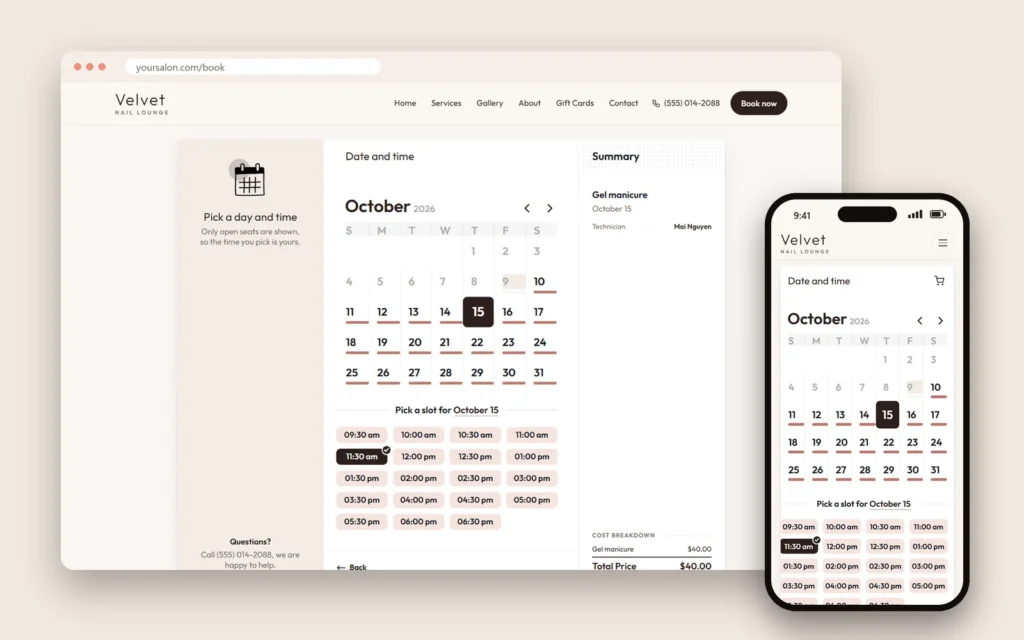
Booking needs services, durations, staff and hours set up correctly, plus confirmation emails. It is one of the most valuable features for salons and spas, and one of the most common reasons for a higher website cost.
6. Online ordering or an online store
Selling products or taking food orders adds payment setup, product pages, taxes and shipping or pickup rules. Third-party ordering platforms may charge a commission on every order, which is a cost to compare against a site-based ordering system.
7. Connections to other tools
Point-of-sale systems, email marketing, customer lists and review tools can be connected to your site. Each connection takes setup time.
8. More than one language
A site in English and Vietnamese, or English and Spanish, needs every page written and maintained twice, which raises the website cost. It is worth it when a real share of your customers prefers the second language.
9. Search engine setup
Page titles, descriptions, a Google-friendly structure, business details that match your Google Business Profile, and a connection to Google Search Console. This is what helps the site, and your map listing, show up for local searches.
10. Speed and accessibility
Fast loading on phones, readable text, good color contrast, image descriptions and working keyboard navigation take care to build. They also help more people use your site and keep you on the right side of accessibility expectations.
11. Ongoing care
Some prices include updates and support; others charge for every change. Ask what happens when you need new prices, holiday hours or a new photo.
Website cost by type of business
The same eleven factors weigh differently depending on what you sell.
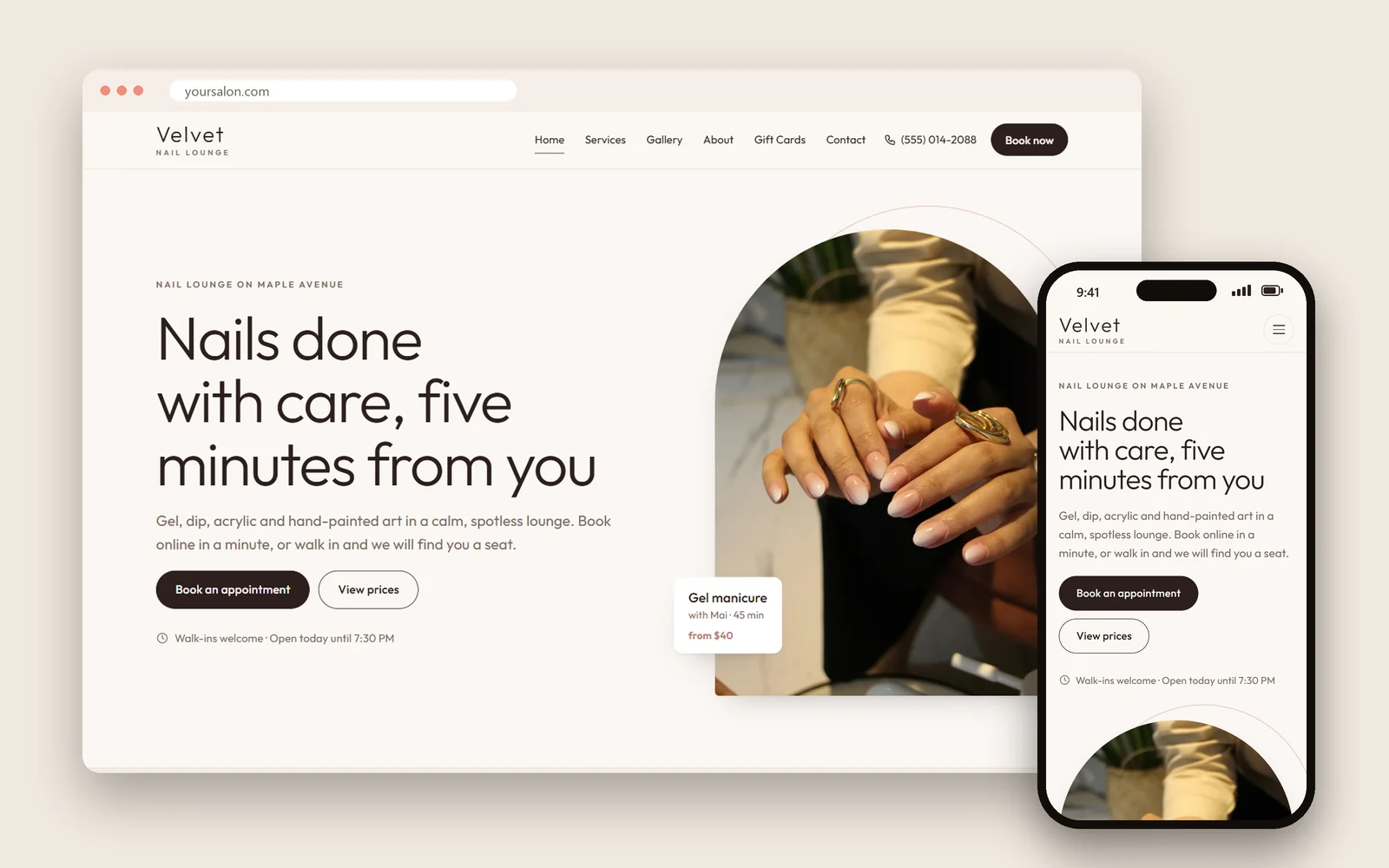
Nail salons, spas, lash and hair studios. Online booking is the feature that pays for itself: clients book at night, staff answer fewer calls, and confirmation emails help with no-shows. Expect the booking setup to be the biggest line after design. A gallery of real work and a clear price list matter more than fancy animation.
Restaurants and cafés. A menu written as text, not a PDF or a photo, is the core, because Google and customers can both read it. Online ordering, reservations and catering requests add cost. Compare a site-based ordering system against the commission third-party apps charge on every order.
Bakeries. Pre-orders for birthday and wedding cakes need a clear form with dates, sizes and deposits. Seasonal pages for holidays add a little cost but often lead into the busiest weeks of the year.
Retail shops. An online store is the most expensive option, because every product needs photos, prices, stock and shipping or pickup rules. Many small shops start with a showcase site and a "call to order" button, then add a store later.
Home services and contractors. Service area pages, a quote request form and before-and-after photos. These sites are usually simple to build; the work is in the content for each service and area.
Do-it-yourself vs. hiring: the real cost of your time
Builders advertise a low monthly price, and for some owners that is the right choice. Before you decide, count the hours honestly:
- Learning the builder and choosing a template.
- Writing every page, including prices and policies.
- Taking, choosing and resizing photos.
- Setting up booking or ordering, and testing it on your phone.
- Setting page titles and descriptions, and connecting Google tools.
- Keeping everything up to date for years.
Many owners start a builder site on a quiet weekend and never finish it, or finish it once and never update it. A site with last year's prices costs you more in confused customers than the price of help. If you do build it yourself, use Google's SEO starter guide as a checklist and test the speed with PageSpeed Insights.
Compare quotes over three years, not one
A first-year price tells you very little. The fair way to compare is the total small business website cost over three years:
- The upfront price, including everything you need at launch.
- Plus two years of renewals: domain, hosting and licenses.
- Plus the changes you expect: new prices every year, holiday hours, new photos.
- Plus monthly fees for booking, ordering or email, if they are separate.
A package with a higher first year but low renewals and free small changes is often cheaper by year three than a "free website" with a monthly contract. Write the three-year total next to each quote before you choose.
Hidden fees to ask about
- Who owns the domain? If it is registered in the designer's name, moving away later can be painful. ICANN explains what domain owners are entitled to.
- Is the first-year price a promotion? Hosting and builder plans often renew at a higher price.
- Are there per-change fees? A cheap site with expensive updates is not cheap.
- Do plugins or tools need paid licenses that renew every year?
- Is there a long contract behind a "free website" offer?
- What does leaving cost? Ask whether you can take your content and domain with you.
A fair website cost is one you can predict: the same price next year, and no surprise invoice for a new photo.
How to lower the website cost without hurting results
- Write the first draft yourself. You know your services better than anyone; a designer can polish your words much faster than write them from nothing.
- Send good phone photos. Daylight, a clean background and real work beat stock photos.
- Start with the pages customers ask about. Home, services and prices, booking or menu, contact. Add a blog or extra pages later.
- Choose a proven layout. A layout built for your type of business has already solved where the booking button goes.
- Skip features you will not use. Sliders, video backgrounds and pop-ups add cost and slow the site down.
- Keep everything in your name. It costs nothing at the start and saves a lot if you ever change providers.
Website design cost for small business: what you get back
A website pays for itself through calls, bookings and orders, not through visits. Think of the website cost the way you think of a new nail station or a better oven: it should pay back in customers. Before launch, decide how you will measure it: calls from the site, online bookings, direction requests and orders. Check them every month. If a page gets visits but no bookings, the problem is usually unclear prices or a hard-to-find button, and that is a cheap fix.
Accessibility is part of the value too. Clear text, good contrast and image descriptions let more customers use the site, and the W3C introduction to web accessibility explains the basics in plain language.
How to choose the right package
Start with what the site must do for your business, not with a price:
- What is the one action you want visitors to take: call, book, order or visit?
- Which pages do customers ask about most often on the phone?
- Do you need booking, ordering or a store now, or later?
- Who will update prices, hours and photos?
- Which languages do your customers speak?
Then compare offers that include the same things. Ask to see sites the provider built for businesses like yours, and open them on your phone.
What Dreamer charges
Dreamer builds websites for salons, spas, restaurants and shops in the US and Canada, with the website cost published up front:
| Plan | First year | From year two |
|---|---|---|
| Showcase website | $200 | $129 a year (domain and hosting) |
| Booking or online store website | $300 | $129 a year (domain and hosting) |
The first-year price includes the domain and hosting. You can open our website demos on your phone to see the layouts, or read what makes a good small business website.

Frequently asked questions
Is a cheap website worth it?
It can be, if it is fast, clear, owned by you and easy to update. A low price becomes a problem when the domain is not yours, changes cost extra, or the site was never built to show up on Google.
Can I move my website later?
Usually yes, if you own the domain and can export your content. Ask before you start, not when you want to leave.
How long does a small business website take?
A template-based site for a local business often takes a couple of weeks, mostly waiting for photos, prices and texts. Custom design and online stores take longer.
Should I pay monthly or upfront?
Either can work. Monthly plans spread the cost but often add up to more over three years, and some come with a contract you cannot leave early. Upfront pricing with a yearly renewal is easier to compare. Ask for the three-year total either way.
Do I need to pay for SEO separately?
Basic search setup, meaning titles, descriptions, business details, a sitemap and a connection to Google Search Console, should be part of any website. Ongoing work such as Google Business Profile updates, weekly posts and review replies is a separate service, because it continues every week.
Why do website cost quotes vary so much?
Because they include different things. One quote may cover writing, photos, booking setup and search setup; another may cover only the design. Line up the quotes against the list in this guide, and the gap usually makes sense. If it still does not, ask the provider to explain the website cost line by line.
What is a fair website design cost for small business owners just starting out?
Start with what you need to open: a fast showcase site with services, prices, hours, a map and contact details, all in your name. Add booking, ordering or a store when the business is ready. A fair website design cost for small business owners at this stage covers those basics well, with low renewals and no long contract.
What does a website redesign cost?
Usually less than a first build if your words, photos and domain are ready to reuse, and more if the old site was built on a platform you cannot export from. Ask for the same breakdown as for a new site.